
As an Amazon Associate, Tool Engineers earns from qualifying purchases. Amazon prices and availability are accurate as of the date shown and are subject to change; verify the current listing before purchase.
The best jigsaw for woodworking should handle furniture parts, cabinet cutouts, templates, decorative curves, notches, trim, and mixed shop work with good blade control. For woodworking, the most important features are blade guidance, shoe stability, variable speed, orbital control, visibility, tool-free blade changes, and predictable bevel adjustment.
For a corded shop, the Bosch JS470E is the strongest all-around woodworking platform because it combines a 7A motor, 500–3,100 SPM range, 1 in. stroke, Constant Response circuitry, four orbital settings, T-shank clamping, die-cast aluminum footplate, and a low-vibration plunging mechanism. For cordless users, the DEWALT DCS334B, Makita XVJ04Z, and Milwaukee 2737-20 are the main platform choices.
We did not perform original cut testing. No cut-speed, blade-deflection, vibration, dust, or edge-quality scores are invented. Manufacturer documentation and realistic woodworking workflow are used throughout.
Quick Picks
- Best overall corded: Bosch JS470E.
- Best 20V MAX cordless: DEWALT DCS334B.
- Best Makita LXT: XVJ04Z.
- Best M18: Milwaukee 2737-20.
- Best lower-cost Bosch: JS260.
- Best Bosch step-up alternative: JS365.
- Best DIY corded value: SKIL JS314901.
- Best V20 cordless: CRAFTSMAN CMCS600B.
- Best visibility-focused hobby option: WEN 33606.
- Best barrel-grip woodworking option: Makita XVJ05Z.
How We Chose Jigsaws for Woodworking
- Blade tracking and guidance: important for furniture edges, templates, and mating parts.
- Shoe stability: the base must remain flat and rigid through curves and bevels.
- Speed control: lets the user match blade/material instead of cutting everything at maximum speed.
- Orbital adjustment: higher settings can speed rough wood cuts; lower/zero settings favor control and cleaner edges.
- Blade-change workflow: woodworking often means switching between clean-cut, curve, and fast-cutting blades.
- Visibility: LED/blower/extraction support help keep the layout line visible.
- Grip choice: top-handle and barrel-grip designs can both work; preference and task matter.
Quick Comparison
| Model | Price | Power | Speed | Woodworking Strength |
|---|---|---|---|---|
| Bosch JS470E | $199.00 | 7A corded | 500–3,100 SPM | 1 in. stroke + Constant Response |
| DEWALT DCS334B | $132.85 | 20V MAX XR | Variable | Brushless + LED/blower + four orbital positions |
| Makita XVJ04Z | $218.95 | 18V LXT | 0–3,000 SPM | Brushless + compact top handle |
| Milwaukee 2737-20 | — | M18 FUEL | 0–3,500 SPM | Brushless + 1 in. stroke + dust tube |
| Bosch JS260 | $119.00 | 6A corded | 500–3,100 SPM | Low-vibration + sturdy footplate |
| Bosch JS365 | $119.00 | 6.5A corded | 500–3,100 SPM | 1 in. stroke + die-cast footplate |
| SKIL JS314901 | $51.80 | 6A corded | 800–3,200 SPM | Halo Light + four orbital settings |
| CRAFTSMAN CMCS600B | $87.55 | V20 | 0–2,500 SPM | Simple cordless platform |
| WEN 33606 | $32.44 | 6.6A corded | 0–3,300 SPM | Laser + LED + blower/dust port |
| Makita XVJ05Z | $219.99 | 18V LXT | 800–3,000 SPM | Low barrel grip + soft no-load mode |
1. Bosch JS470E — Best Overall Corded Woodworking Jigsaw

Bosch specifies a 7A motor, 500–3,100 SPM, 1 in. stroke, four orbital settings, Constant Response circuitry, T-shank-only clamping, die-cast aluminum footplate, and low-vibration plunging action. It is a strong bench/shop choice where continuous corded runtime matters.
- Best for: Best Overall Corded Woodworking Jigsaw where blade guidance, shoe stability, speed/orbit control, visibility, and blade-change workflow match furniture, cabinet, template, trim, and mixed shop work.
- Why we picked it: Bosch JS470E fills a distinct woodworking role based on corded/cordless format, stroke and speed control, shoe construction, grip style, and how easily the user can switch between clean-cut, curve, and fast-cut blades.
- Key strengths: controlled blade tracking, practical orbital adjustment, stable shoe support, and a platform suited to varied shop cuts instead of one material-only niche.
- Important limitations: a jigsaw still has a one-ended blade; thick stock, narrow curves, dull blades, and sideways steering can create deflection even on premium tools.
- What to check before buying: T-shank blade range, stroke/SPM, orbital settings, shoe squareness, blower/extraction, bevel mechanism, battery ecosystem, and whether the job needs a straighter-cut tool.
- Who should buy it: woodworkers who need one versatile saw for furniture cutouts, curves, notches, templates, and portable shop work.
- Who should skip it: users whose primary work is long glue-ready rips, repeated thick-stock precision, or joinery-critical square edges.
| ✅ Pros | ❌ Cons |
|---|---|
| • 7A motor • 1 in. stroke • Constant Response • Die-cast shoe • T-shank clamp | • Corded • Not the lightest platform |
Manufacturer specs | Exact JS470E on Amazon
2. DEWALT DCS334B — Best 20V MAX Woodworking Option
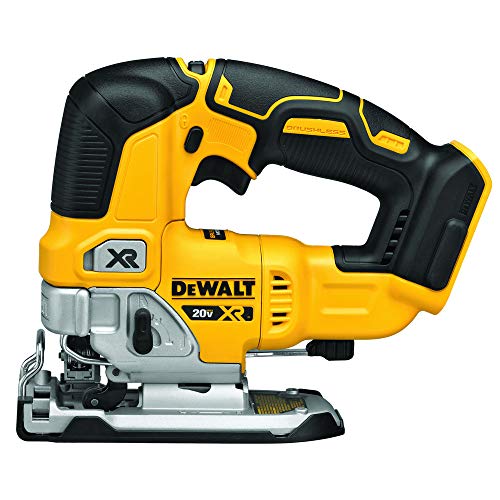
The DCS334B uses a brushless motor, variable-speed trigger and dial, four orbital positions, all-metal keyless T-shank clamp, keyless shoe bevel, LED light, dust blower, and no-mar shoe cover.
- Best for: Best 20V MAX Woodworking Option where blade guidance, shoe stability, speed/orbit control, visibility, and blade-change workflow match furniture, cabinet, template, trim, and mixed shop work.
- Why we picked it: DEWALT DCS334B fills a distinct woodworking role based on corded/cordless format, stroke and speed control, shoe construction, grip style, and how easily the user can switch between clean-cut, curve, and fast-cut blades.
- Key strengths: controlled blade tracking, practical orbital adjustment, stable shoe support, and a platform suited to varied shop cuts instead of one material-only niche.
- Important limitations: a jigsaw still has a one-ended blade; thick stock, narrow curves, dull blades, and sideways steering can create deflection even on premium tools.
- What to check before buying: T-shank blade range, stroke/SPM, orbital settings, shoe squareness, blower/extraction, bevel mechanism, battery ecosystem, and whether the job needs a straighter-cut tool.
- Who should buy it: woodworkers who need one versatile saw for furniture cutouts, curves, notches, templates, and portable shop work.
- Who should skip it: users whose primary work is long glue-ready rips, repeated thick-stock precision, or joinery-critical square edges.
| ✅ Pros | ❌ Cons |
|---|---|
| • Brushless • Variable trigger + dial • Four orbital positions • LED + blower • No-mar shoe | • Battery/charger separate • Battery adds hand weight |
Manufacturer specs | Exact DCS334B on Amazon
3. Makita XVJ04Z — Best LXT Top-Handle Option

Makita specifies an 18V LXT brushless motor, 0–3,000 SPM, 7/8 in. stroke, three orbital settings plus straight cutting, tool-less blade change, LED lighting, dust blower, and soft no-load mode.
- Best for: Best LXT Top-Handle Option where blade guidance, shoe stability, speed/orbit control, visibility, and blade-change workflow match furniture, cabinet, template, trim, and mixed shop work.
- Why we picked it: Makita XVJ04Z fills a distinct woodworking role based on corded/cordless format, stroke and speed control, shoe construction, grip style, and how easily the user can switch between clean-cut, curve, and fast-cut blades.
- Key strengths: controlled blade tracking, practical orbital adjustment, stable shoe support, and a platform suited to varied shop cuts instead of one material-only niche.
- Important limitations: a jigsaw still has a one-ended blade; thick stock, narrow curves, dull blades, and sideways steering can create deflection even on premium tools.
- What to check before buying: T-shank blade range, stroke/SPM, orbital settings, shoe squareness, blower/extraction, bevel mechanism, battery ecosystem, and whether the job needs a straighter-cut tool.
- Who should buy it: woodworkers who need one versatile saw for furniture cutouts, curves, notches, templates, and portable shop work.
- Who should skip it: users whose primary work is long glue-ready rips, repeated thick-stock precision, or joinery-critical square edges.
| ✅ Pros | ❌ Cons |
|---|---|
| • Brushless • 0–3,000 SPM • Compact handling • Straight mode + orbital control • LED/blower | • Battery/charger separate • 7/8 in. stroke is shorter than some 1 in. competitors |
Manufacturer specs | Exact XVJ04Z on Amazon
4. Milwaukee 2737-20 — Best M18 Woodworking Option
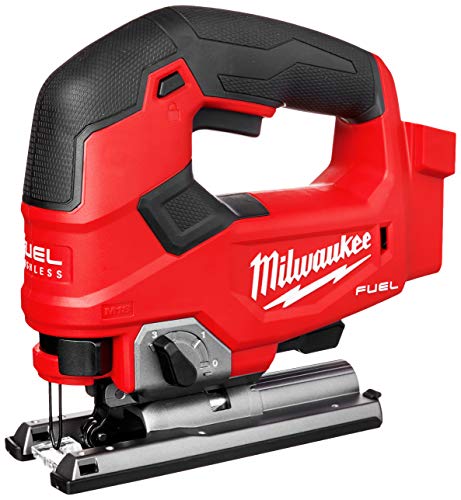
Milwaukee specifies a POWERSTATE brushless motor, 0–3,500 SPM, 1 in. stroke, four orbital settings, T-shank blades, tool-free bevel and blade changes, LED light, switchable blower, and dust-extraction tube.
- Best for: Best M18 Woodworking Option where blade guidance, shoe stability, speed/orbit control, visibility, and blade-change workflow match furniture, cabinet, template, trim, and mixed shop work.
- Why we picked it: Milwaukee 2737-20 fills a distinct woodworking role based on corded/cordless format, stroke and speed control, shoe construction, grip style, and how easily the user can switch between clean-cut, curve, and fast-cut blades.
- Key strengths: controlled blade tracking, practical orbital adjustment, stable shoe support, and a platform suited to varied shop cuts instead of one material-only niche.
- Important limitations: a jigsaw still has a one-ended blade; thick stock, narrow curves, dull blades, and sideways steering can create deflection even on premium tools.
- What to check before buying: T-shank blade range, stroke/SPM, orbital settings, shoe squareness, blower/extraction, bevel mechanism, battery ecosystem, and whether the job needs a straighter-cut tool.
- Who should buy it: woodworkers who need one versatile saw for furniture cutouts, curves, notches, templates, and portable shop work.
- Who should skip it: users whose primary work is long glue-ready rips, repeated thick-stock precision, or joinery-critical square edges.
| ✅ Pros | ❌ Cons |
|---|---|
| • 0–3,500 SPM • 1 in. stroke • Brushless M18 platform • Switchable blower • Dust tube included | • Battery/charger separate • High maximum speed is not needed for every cut |
Manufacturer specs | Exact 2737-20 on Amazon
5. Bosch JS260 — Best Lower-Cost Bosch Corded Pick

BOSCH JS260 Top-Handle Jig Saw - 6.0 Amp Motor, Variable Speed Control, Low-Vibration Plunging Design, Toolless Blade Change System - Ideal for Accurate and Smooth Cutting
The JS260 uses a 6A motor, 500–3,100 SPM, 3/4 in. stroke, four orbital settings, T-shank clamp, heavy-gauge steel footplate, and low-vibration plunging action.
- Best for: Best Lower-Cost Bosch Corded Pick where blade guidance, shoe stability, speed/orbit control, visibility, and blade-change workflow match furniture, cabinet, template, trim, and mixed shop work.
- Why we picked it: Bosch JS260 fills a distinct woodworking role based on corded/cordless format, stroke and speed control, shoe construction, grip style, and how easily the user can switch between clean-cut, curve, and fast-cut blades.
- Key strengths: controlled blade tracking, practical orbital adjustment, stable shoe support, and a platform suited to varied shop cuts instead of one material-only niche.
- Important limitations: a jigsaw still has a one-ended blade; thick stock, narrow curves, dull blades, and sideways steering can create deflection even on premium tools.
- What to check before buying: T-shank blade range, stroke/SPM, orbital settings, shoe squareness, blower/extraction, bevel mechanism, battery ecosystem, and whether the job needs a straighter-cut tool.
- Who should buy it: woodworkers who need one versatile saw for furniture cutouts, curves, notches, templates, and portable shop work.
- Who should skip it: users whose primary work is long glue-ready rips, repeated thick-stock precision, or joinery-critical square edges.
| ✅ Pros | ❌ Cons |
|---|---|
| • 6A / 500–3,100 SPM • Four orbital settings • Low vibration • T-shank clamp | • Shorter 3/4 in. stroke • Always-on blower |
Manufacturer specs | Exact JS260 on Amazon
6. Bosch JS365 — Best Bosch Step-Up Alternative
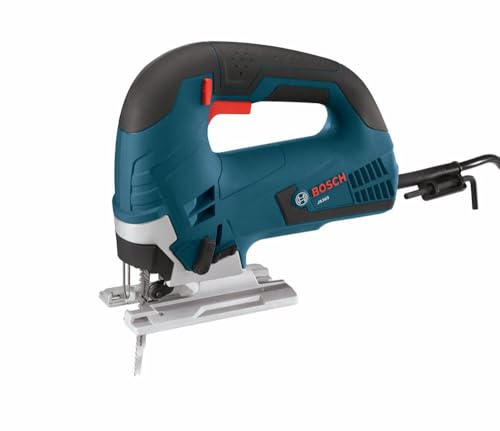
BOSCH JS365 120V 6.5 Amp Top-Handle Jigsaw Kit Variable Speed, 45 Degree Bevel Cuts, Up to 3,000 SPM
The JS365 adds a 6.5A motor, 500–3,100 SPM, 1 in. stroke, four orbital settings, die-cast aluminum footplate, T-shank clamp, and switchable blower.
- Best for: Best Bosch Step-Up Alternative where blade guidance, shoe stability, speed/orbit control, visibility, and blade-change workflow match furniture, cabinet, template, trim, and mixed shop work.
- Why we picked it: Bosch JS365 fills a distinct woodworking role based on corded/cordless format, stroke and speed control, shoe construction, grip style, and how easily the user can switch between clean-cut, curve, and fast-cut blades.
- Key strengths: controlled blade tracking, practical orbital adjustment, stable shoe support, and a platform suited to varied shop cuts instead of one material-only niche.
- Important limitations: a jigsaw still has a one-ended blade; thick stock, narrow curves, dull blades, and sideways steering can create deflection even on premium tools.
- What to check before buying: T-shank blade range, stroke/SPM, orbital settings, shoe squareness, blower/extraction, bevel mechanism, battery ecosystem, and whether the job needs a straighter-cut tool.
- Who should buy it: woodworkers who need one versatile saw for furniture cutouts, curves, notches, templates, and portable shop work.
- Who should skip it: users whose primary work is long glue-ready rips, repeated thick-stock precision, or joinery-critical square edges.
| ✅ Pros | ❌ Cons |
|---|---|
| • 1 in. stroke • Die-cast footplate • Four orbital settings • Switchable blower | • No Constant Response feature • Corded only |
Manufacturer specs | Exact JS365 on Amazon
7. SKIL JS314901 — Best DIY Corded Woodworking Value
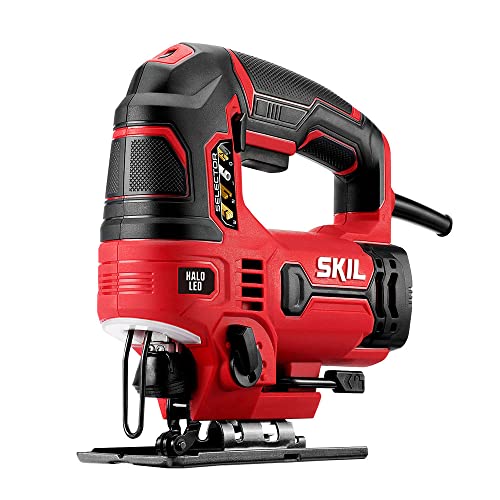
SKIL specifies a 6A motor, 800–3,200 SPM, 7/8 in. stroke, four orbital settings, Halo Light, tool-free blade clamp, and tool-free bevel adjustment.
- Best for: Best DIY Corded Woodworking Value where blade guidance, shoe stability, speed/orbit control, visibility, and blade-change workflow match furniture, cabinet, template, trim, and mixed shop work.
- Why we picked it: SKIL JS314901 fills a distinct woodworking role based on corded/cordless format, stroke and speed control, shoe construction, grip style, and how easily the user can switch between clean-cut, curve, and fast-cut blades.
- Key strengths: controlled blade tracking, practical orbital adjustment, stable shoe support, and a platform suited to varied shop cuts instead of one material-only niche.
- Important limitations: a jigsaw still has a one-ended blade; thick stock, narrow curves, dull blades, and sideways steering can create deflection even on premium tools.
- What to check before buying: T-shank blade range, stroke/SPM, orbital settings, shoe squareness, blower/extraction, bevel mechanism, battery ecosystem, and whether the job needs a straighter-cut tool.
- Who should buy it: woodworkers who need one versatile saw for furniture cutouts, curves, notches, templates, and portable shop work.
- Who should skip it: users whose primary work is long glue-ready rips, repeated thick-stock precision, or joinery-critical square edges.
| ✅ Pros | ❌ Cons |
|---|---|
| • Wide speed range • Four orbital settings • Halo Light • Tool-free adjustments | • Less refined than premium platforms • Corded |
Manufacturer specs | Exact JS314901 on Amazon
8. CRAFTSMAN CMCS600B — Best V20 Alternative

The CMCS600B offers 0–2,500 SPM, three orbital settings, 45° bevel capability, dust blower, contoured grip, and both T- and U-shank compatibility.
- Best for: Best V20 Alternative where blade guidance, shoe stability, speed/orbit control, visibility, and blade-change workflow match furniture, cabinet, template, trim, and mixed shop work.
- Why we picked it: CRAFTSMAN CMCS600B fills a distinct woodworking role based on corded/cordless format, stroke and speed control, shoe construction, grip style, and how easily the user can switch between clean-cut, curve, and fast-cut blades.
- Key strengths: controlled blade tracking, practical orbital adjustment, stable shoe support, and a platform suited to varied shop cuts instead of one material-only niche.
- Important limitations: a jigsaw still has a one-ended blade; thick stock, narrow curves, dull blades, and sideways steering can create deflection even on premium tools.
- What to check before buying: T-shank blade range, stroke/SPM, orbital settings, shoe squareness, blower/extraction, bevel mechanism, battery ecosystem, and whether the job needs a straighter-cut tool.
- Who should buy it: woodworkers who need one versatile saw for furniture cutouts, curves, notches, templates, and portable shop work.
- Who should skip it: users whose primary work is long glue-ready rips, repeated thick-stock precision, or joinery-critical square edges.
| ✅ Pros | ❌ Cons |
|---|---|
| • V20 platform • Three orbital settings • T/U-shank support • Simple cordless operation | • Brushed/basic platform • Battery/charger separate |
Manufacturer specs | Exact CMCS600B on Amazon
9. WEN 33606 — Best Visibility-Focused Hobby Option
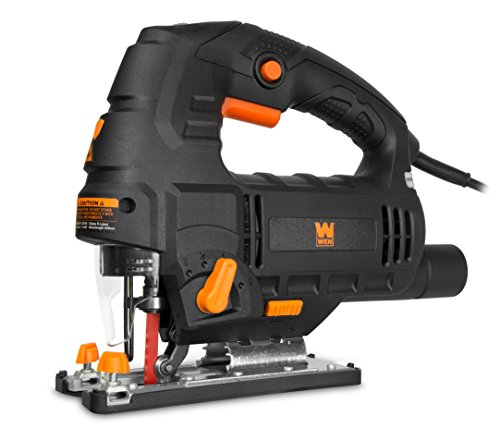
WEN lists a 6.6A motor, 0–3,300 SPM, four-position orbital selector, laser, LED, front blower, 1-1/2 in. dust port, non-marring shoe, and tool-free blade change.
- Best for: Best Visibility-Focused Hobby Option where blade guidance, shoe stability, speed/orbit control, visibility, and blade-change workflow match furniture, cabinet, template, trim, and mixed shop work.
- Why we picked it: WEN 33606 fills a distinct woodworking role based on corded/cordless format, stroke and speed control, shoe construction, grip style, and how easily the user can switch between clean-cut, curve, and fast-cut blades.
- Key strengths: controlled blade tracking, practical orbital adjustment, stable shoe support, and a platform suited to varied shop cuts instead of one material-only niche.
- Important limitations: a jigsaw still has a one-ended blade; thick stock, narrow curves, dull blades, and sideways steering can create deflection even on premium tools.
- What to check before buying: T-shank blade range, stroke/SPM, orbital settings, shoe squareness, blower/extraction, bevel mechanism, battery ecosystem, and whether the job needs a straighter-cut tool.
- Who should buy it: woodworkers who need one versatile saw for furniture cutouts, curves, notches, templates, and portable shop work.
- Who should skip it: users whose primary work is long glue-ready rips, repeated thick-stock precision, or joinery-critical square edges.
| ✅ Pros | ❌ Cons |
|---|---|
| • Variable speed • Laser + LED • Dust port/blower • Non-marring shoe | • Laser does not prevent blade deflection • Hobby-oriented platform |
Manufacturer specs | Exact WEN 33606 on Amazon
10. Makita XVJ05Z — Best Barrel-Grip Woodworking Option

The XVJ05Z uses an 18V LXT brushless motor, barrel grip close to the work surface, 800–3,000 SPM, three orbital settings plus straight cutting, soft no-load mode, LED lighting, dust blower, and tool-less blade change.
- Best for: Best Barrel-Grip Woodworking Option where blade guidance, shoe stability, speed/orbit control, visibility, and blade-change workflow match furniture, cabinet, template, trim, and mixed shop work.
- Why we picked it: Makita XVJ05Z fills a distinct woodworking role based on corded/cordless format, stroke and speed control, shoe construction, grip style, and how easily the user can switch between clean-cut, curve, and fast-cut blades.
- Key strengths: controlled blade tracking, practical orbital adjustment, stable shoe support, and a platform suited to varied shop cuts instead of one material-only niche.
- Important limitations: a jigsaw still has a one-ended blade; thick stock, narrow curves, dull blades, and sideways steering can create deflection even on premium tools.
- What to check before buying: T-shank blade range, stroke/SPM, orbital settings, shoe squareness, blower/extraction, bevel mechanism, battery ecosystem, and whether the job needs a straighter-cut tool.
- Who should buy it: woodworkers who need one versatile saw for furniture cutouts, curves, notches, templates, and portable shop work.
- Who should skip it: users whose primary work is long glue-ready rips, repeated thick-stock precision, or joinery-critical square edges.
| ✅ Pros | ❌ Cons |
|---|---|
| • Low barrel grip • Brushless LXT platform • Soft no-load mode • LED + blower | • Grip style is preference-sensitive • Battery/charger separate |
Manufacturer specs | Exact XVJ05Z on Amazon
Blade Selection for Woodworking
Choose by material, stock thickness, cut direction, radius, and finish. Narrow scrolling blades turn tighter curves; wider/stiffer blades help straight cuts; clean-cut blades trade speed for edge quality.
Managing Blade Deflection
Keep the shoe planted, use a sharp blade long enough for the stock, and reduce sideways steering pressure. Check the underside of thick work because a one-ended jigsaw blade can drift even when the top tracks the line.
Orbital Action and Edge Quality
Higher orbital action can speed rough wood cuts but may increase tear-out. Lower/zero orbital action is usually better for clean edges, tight curves, veneer, and delicate work.
When a Jigsaw Is the Wrong Tool
Long precision rips, joinery-critical square edges, and repeated thick-stock parts may be better handled by a table saw, track saw, bandsaw, or router/template process.
Manufacturer References
- Bosch Tools, DEWALT, and Makita — jigsaw speed, stroke, orbital action, shoe, blade-clamp, and platform specifications.
- Milwaukee Tool, SKIL, WEN, and CRAFTSMAN — current woodworking-relevant jigsaw specifications.
FAQ
What matters most in a woodworking jigsaw?
Blade choice, guidance, shoe stability, speed/orbital control, visibility, and controlled feed.
Can a jigsaw make furniture-quality cuts?
Yes for many curves/cutouts, but edges may need sanding or routing and some precision operations are better done with another tool.
Which guide should I use for hardwood or plywood?
Use Tool Engineers’ dedicated material-specific guides; those prioritize different blade/tear-out/deflection concerns.
What about very tight curves?
Use the separate curve-cutting guide, where blade width, relief cuts, and minimum radius are the main intent.
Who Should Buy Which Jigsaw?
- Best corded all-round shop saw: Bosch JS470E.
- Existing 20V MAX user: DEWALT DCS334B.
- Existing LXT user: Makita XVJ04Z or barrel-grip XVJ05Z.
- Existing M18 user: Milwaukee 2737-20.
- Lower-cost corded workshop: Bosch JS260/JS365 or SKIL JS314901.
- Hobby visibility priority: WEN 33606.
Included Contents and Blade Budget
Verify whether the exact SKU is tool-only or kit and whether it includes blades, no-mar shoe, dust adapter, case, battery, or charger. Budget separately for clean-cut, scrolling, fast-rip, laminate/plywood, and specialty blades as needed.
Who Should Skip a Jigsaw?
Skip the jigsaw as the primary tool when the job requires long straight glue-ready rips, repeated identical thick-stock parts, or joinery-critical edges. A table saw, track saw, bandsaw, router/template, or CNC process may be the better woodworking method.
Warranty, Value, and Availability
Compare current manufacturer warranty, battery replacement cost, blade availability, shoe/dust accessories, and service support. Cordless value depends heavily on whether the user already owns the battery platform.
Related Tool Engineers Guides
For tight curves, see Tool Engineers’ circle-cutting guide and barrel-grip vs. top-handle comparison. Hardwood, plywood, beginner, curve, and value pages remain separate intents.
Final Verdict
The Bosch JS470E is the strongest all-around corded woodworking jigsaw because its guidance, shoe, speed control, orbital settings, and Constant Response system suit varied shop work. Choose cordless by battery platform when mobility matters.
This page stays broad—furniture, cabinet, template, trim, and mixed woodworking—while Tool Engineers’ hardwood, plywood, curve, beginner, and value jigsaw pages remain separate intents.
