
As an Amazon Associate, Tool Engineers earns from qualifying purchases. Amazon prices and availability are accurate as of the date shown and are subject to change; verify the current listing before purchase.
The best jigsaw for hardwood is not simply the saw with the highest strokes-per-minute number. Dense oak, maple, hickory, beech, and other hardwoods increase cutting load, heat, and the risk of blade deflection. For hardwood, the better tool is the one that lets you keep a sharp blade supported, maintain steady shoe contact, control feed rate, and use the correct speed/orbital setting for the cut.
For a corded shop, the Bosch JS470E is the strongest all-around pick here because Bosch combines a 7A motor, 500–3,100 SPM control, a 1-inch stroke, four orbital settings, a die-cast aluminum footplate, T-shank blade clamping, Constant Response circuitry, and a low-vibration plunging mechanism. For cordless work, the Milwaukee 2737-20 and DEWALT DCS334B are the strongest platform choices, while the Makita XVJ04Z stands out for a manufacturer-listed wood cutting capacity of 5-5/16 inches with the correct setup.
We did not perform original hardwood cutting tests for this roundup. No blade-deflection, heat, cut-speed, vibration, or edge-quality scores are invented. Manufacturer claims are identified as such, and hardwood recommendations are based on documented controls plus realistic cutting practice.
Quick Picks
- Best overall corded: Bosch JS470E — 7A, 500–3,100 SPM, 1 in. stroke, four orbital settings, Constant Response.
- Best DEWALT cordless: DCS334B — brushless 20V MAX XR, four orbital positions, variable-speed trigger/dial, LED and blower.
- Best M18 cordless: Milwaukee 2737-20 — up to 3,500 SPM, POWERSTATE brushless motor, four orbital settings, T-shank blades.
- Best Makita LXT option: XVJ04Z — brushless, 0–3,000 SPM, 7/8 in. stroke, 5-5/16 in. manufacturer-listed wood capacity.
- Best Bosch mid-tier corded: JS365 — 6.5A, 500–3,100 SPM, four orbital settings, die-cast aluminum footplate.
- Best DEWALT corded: DW331K — 6.5A, 500–3,100 SPM, four cutting actions, all-metal gear case.
- Best hobby corded value: SKIL JS314901 — 6A, 800–3,200 SPM, 7/8 in. stroke, 3-3/8 in. wood capacity.
- Best ONE+ HP option: RYOBI PBLJS01B — brushless, 800–3,400 SPM, four orbital settings, tool-free bevel.
- Best lower-cost Bosch corded: JS260 — 6A, 500–3,100 SPM, 3/4 in. stroke, four orbital settings.
- Best V20 option: CRAFTSMAN CMCS600B — 0–2,500 SPM, three orbital settings, 45° bevel, T/U-shank compatibility.
How We Chose Jigsaws for Hardwood
- Control under load: dense wood rewards steady feed and speed control more than headline cutting speed.
- Blade guidance: thick hardwood magnifies deflection, especially with narrow/flexible blades and tight curves.
- Speed control: variable speed helps balance cutting rate, heat, chip evacuation, and finish.
- Orbital control: straight action usually favors control and cleaner results; aggressive orbital action can increase tear-out and deflection.
- Shoe stability: a rigid shoe planted flat on the workpiece helps reduce steering errors.
- Blade system: T-shank compatibility is preferred for secure clamping and broad blade availability.
- Dust visibility: blower/LED systems help the operator follow a line without pushing sideways on the blade.
- Corded vs. cordless: corded tools offer continuous runtime; cordless tools add mobility and platform convenience.
Quick Comparison
| Model | Price | Power | Speed | Hardwood Strength |
|---|---|---|---|---|
| Bosch JS470E | $199.00 | 7A corded | 500–3,100 SPM | Constant Response + 1 in. stroke + rigid footplate |
| DEWALT DCS334B | $141.00 | 20V MAX XR | Variable | Brushless + four orbital positions + LED/blower |
| Milwaukee 2737-20 | $184.00 | M18 FUEL | 0–3,500 SPM | Brushless + high blade speed + dust extraction support |
| Makita XVJ04Z | $199.98 | 18V LXT | 0–3,000 SPM | Brushless + 5-5/16 in. listed wood capacity |
| Bosch JS365 | $119.00 | 6.5A corded | 500–3,100 SPM | 1 in. stroke + die-cast footplate |
| DEWALT DW331K | $178.99 | 6.5A corded | 500–3,100 SPM | All-metal gear case + four cutting actions |
| SKIL JS314901 | $54.00 | 6A corded | 800–3,200 SPM | 3-3/8 in. wood capacity + four orbital settings |
| RYOBI PBLJS01B | $117.00 | 18V ONE+ HP | 800–3,400 SPM | Brushless + four orbital settings + die-cast base |
| Bosch JS260 | $119.00 | 6A corded | 500–3,100 SPM | Low-vibration mechanism + sturdy steel footplate |
| CRAFTSMAN CMCS600B | $87.55 | V20 | 0–2,500 SPM | Three orbital settings + T/U-shank flexibility |
1. Bosch JS470E — Best Overall Corded Jigsaw for Hardwood

Bosch specifies the JS470E with a 7A motor, 500–3,100 SPM variable speed, 1-inch stroke, four orbital-action settings, die-cast aluminum footplate, T-shank-only multidirectional blade clamp, Constant Response circuitry, and a low-vibration plunging mechanism.
For hardwood, the biggest advantage is control. Dense stock can slow a blade and tempt the operator to push harder; Constant Response is designed to maintain performance under load, while the rigid footplate and 1-inch stroke help keep the cut stable when the blade and feed rate are appropriate.
- Best for: Best Overall Corded Jigsaw for Hardwood where blade stiffness, speed/orbit control, shoe stability, and feed technique matter.
- Why we picked it: Bosch JS470E fits a distinct hardwood workflow based on motor/platform, speed control, stroke, orbital settings, shoe rigidity, and blade guidance under dense-stock load.
- Key strengths: controlled stroke rate, stable shoe, secure T-shank clamping, and enough power/control to cut hardwood without forcing the saw.
- Important limitations: thick hardwood increases blade deflection, heat, and chip-clearance difficulty; maximum wood capacity is not a guarantee of square joinery-ready cuts.
- What to check before buying: hardwood-rated blade width/thickness/TPI, usable blade length, orbital setting, shoe square, speed range, stock thickness, feed pressure, and whether another saw is better for required squareness.
- Who should buy it: woodworkers making curves, cutouts, and moderate-thickness hardwood parts where jigsaw flexibility matters.
- Who should skip it: users needing repeated thick, perfectly square joinery cuts better handled by bandsaw, table saw, track saw, or another supported-blade process.
| ✅ Pros | ❌ Cons |
|---|---|
| • 7A corded motor • 500–3,100 SPM • 1 in. stroke • Constant Response circuitry • Die-cast aluminum footplate • T-shank blade clamp | • Cord limits mobility • 5.6 lb tool is not the lightest • Maximum published capacity should not be treated as a guarantee of square cuts in thick hardwood |
Manufacturer specifications | View exact JS470E on Amazon
2. DEWALT DCS334B — Best DEWALT Cordless Option
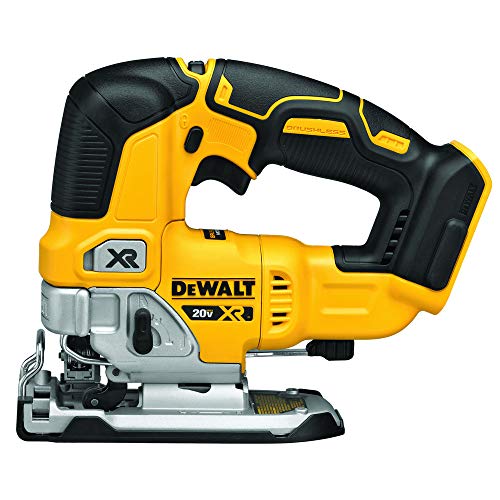
The DCS334B is a 20V MAX XR brushless cordless jigsaw with variable-speed trigger and dial, four-position orbital action, all-metal keyless T-shank blade clamp, all-metal keyless shoe bevel, LED work light, dust blower, and a no-mar shoe cover.
For hardwood, the combination of speed control, rigid shoe adjustment, and clean line visibility matters more than simply running the tool at full speed. The bare-tool format is most attractive if you already own compatible DEWALT batteries.
- Best for: Best DEWALT Cordless Option where blade stiffness, speed/orbit control, shoe stability, and feed technique matter.
- Why we picked it: DEWALT DCS334B fits a distinct hardwood workflow based on motor/platform, speed control, stroke, orbital settings, shoe rigidity, and blade guidance under dense-stock load.
- Key strengths: controlled stroke rate, stable shoe, secure T-shank clamping, and enough power/control to cut hardwood without forcing the saw.
- Important limitations: thick hardwood increases blade deflection, heat, and chip-clearance difficulty; maximum wood capacity is not a guarantee of square joinery-ready cuts.
- What to check before buying: hardwood-rated blade width/thickness/TPI, usable blade length, orbital setting, shoe square, speed range, stock thickness, feed pressure, and whether another saw is better for required squareness.
- Who should buy it: woodworkers making curves, cutouts, and moderate-thickness hardwood parts where jigsaw flexibility matters.
- Who should skip it: users needing repeated thick, perfectly square joinery cuts better handled by bandsaw, table saw, track saw, or another supported-blade process.
| ✅ Pros | ❌ Cons |
|---|---|
| • Brushless 20V MAX XR platform • Variable trigger + speed dial • Four orbital positions • T-shank clamp • LED + blower • No-mar shoe cover | • Battery and charger sold separately • Battery weight affects handling • Runtime varies with battery and hardwood load |
Manufacturer specifications | View exact DCS334B on Amazon
3. Milwaukee 2737-20 — Best M18 FUEL Hardwood Option
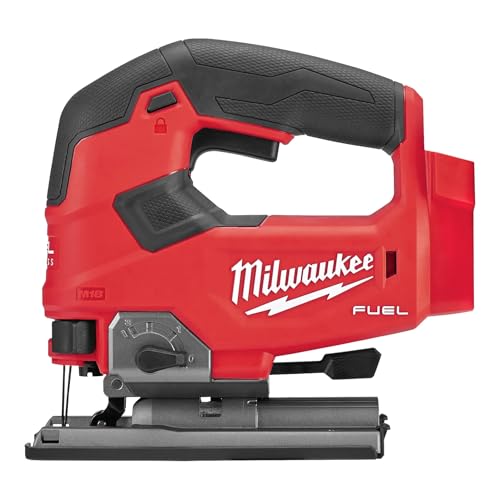
Milwaukee’s 2737-20 M18 FUEL D-handle jigsaw uses a POWERSTATE brushless motor, REDLINK PLUS electronics, variable speed up to 3,500 SPM, four-position orbital action, T-shank blades, tool-free bevel adjustment, LED lighting, switchable blower, and a supplied dust-extraction tube.
Milwaukee explicitly markets this model for hard materials including hardwood. That does not remove the need for the correct blade or feed rate, but the 3,500-SPM ceiling and brushless drive give M18 users a strong cordless platform for dense stock.
- Best for: Best M18 FUEL Hardwood Option where blade stiffness, speed/orbit control, shoe stability, and feed technique matter.
- Why we picked it: Milwaukee 2737-20 fits a distinct hardwood workflow based on motor/platform, speed control, stroke, orbital settings, shoe rigidity, and blade guidance under dense-stock load.
- Key strengths: controlled stroke rate, stable shoe, secure T-shank clamping, and enough power/control to cut hardwood without forcing the saw.
- Important limitations: thick hardwood increases blade deflection, heat, and chip-clearance difficulty; maximum wood capacity is not a guarantee of square joinery-ready cuts.
- What to check before buying: hardwood-rated blade width/thickness/TPI, usable blade length, orbital setting, shoe square, speed range, stock thickness, feed pressure, and whether another saw is better for required squareness.
- Who should buy it: woodworkers making curves, cutouts, and moderate-thickness hardwood parts where jigsaw flexibility matters.
- Who should skip it: users needing repeated thick, perfectly square joinery cuts better handled by bandsaw, table saw, track saw, or another supported-blade process.
| ✅ Pros | ❌ Cons |
|---|---|
| • Up to 3,500 SPM • POWERSTATE brushless motor • Four orbital settings • T-shank blade system • LED, blower, and dust tube • Tool-free bevel adjustment | • Tool-only format requires M18 battery • High maximum speed is not automatically the correct hardwood setting |
Manufacturer specifications | View exact 2737-20 on Amazon
4. Makita XVJ04Z — Best Makita LXT Option

Makita specifies the XVJ04Z with an 18V LXT brushless motor, 0–3,000 SPM variable speed, 7/8-inch stroke, T-shank blade system, orbital settings, tool-less blade change, and a manufacturer-listed maximum wood capacity of 5-5/16 inches at 90°. Makita lists net weight with battery at 5.2 lb.
The large published wood capacity is useful context, but thick hardwood remains a deflection-sensitive cut. Treat the capacity as a mechanical limit, not a promise of furniture-ready squareness at maximum thickness.
- Best for: Best Makita LXT Option where blade stiffness, speed/orbit control, shoe stability, and feed technique matter.
- Why we picked it: Makita XVJ04Z fits a distinct hardwood workflow based on motor/platform, speed control, stroke, orbital settings, shoe rigidity, and blade guidance under dense-stock load.
- Key strengths: controlled stroke rate, stable shoe, secure T-shank clamping, and enough power/control to cut hardwood without forcing the saw.
- Important limitations: thick hardwood increases blade deflection, heat, and chip-clearance difficulty; maximum wood capacity is not a guarantee of square joinery-ready cuts.
- What to check before buying: hardwood-rated blade width/thickness/TPI, usable blade length, orbital setting, shoe square, speed range, stock thickness, feed pressure, and whether another saw is better for required squareness.
- Who should buy it: woodworkers making curves, cutouts, and moderate-thickness hardwood parts where jigsaw flexibility matters.
- Who should skip it: users needing repeated thick, perfectly square joinery cuts better handled by bandsaw, table saw, track saw, or another supported-blade process.
| ✅ Pros | ❌ Cons |
|---|---|
| • Brushless LXT platform • 0–3,000 SPM • 7/8 in. stroke • Tool-less blade change • 5-5/16 in. listed wood capacity • 5.2 lb listed with battery | • Bare tool requires battery/charger • Very thick hardwood may still need a bandsaw or other machine for square results |
Manufacturer specifications | View exact XVJ04Z on Amazon
5. Bosch JS365 — Best Mid-Tier Bosch Corded Alternative
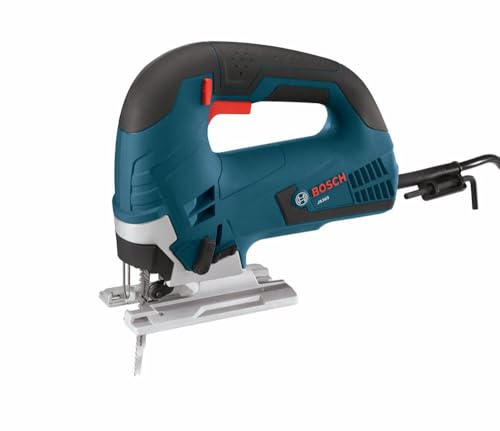
BOSCH JS365 120V 6.5 Amp Top-Handle Jigsaw Kit Variable Speed, 45 Degree Bevel Cuts, Up to 3,000 SPM
The JS365 uses a 6.5A motor, 500–3,100 SPM variable speed, 1-inch stroke, four orbital-action settings, die-cast aluminum footplate, T-shank-only clamp, and a switchable dust blower. Bosch lists a 3-1/2-inch softwood cutting capacity and 5.35 lb weight.
Compared with the JS470E, it gives up the 7A rating and Constant Response circuitry but keeps the stable footplate, long stroke, orbital control, and T-shank clamping that matter in dense wood.
- Best for: Best Mid-Tier Bosch Corded Alternative where blade stiffness, speed/orbit control, shoe stability, and feed technique matter.
- Why we picked it: Bosch JS365 fits a distinct hardwood workflow based on motor/platform, speed control, stroke, orbital settings, shoe rigidity, and blade guidance under dense-stock load.
- Key strengths: controlled stroke rate, stable shoe, secure T-shank clamping, and enough power/control to cut hardwood without forcing the saw.
- Important limitations: thick hardwood increases blade deflection, heat, and chip-clearance difficulty; maximum wood capacity is not a guarantee of square joinery-ready cuts.
- What to check before buying: hardwood-rated blade width/thickness/TPI, usable blade length, orbital setting, shoe square, speed range, stock thickness, feed pressure, and whether another saw is better for required squareness.
- Who should buy it: woodworkers making curves, cutouts, and moderate-thickness hardwood parts where jigsaw flexibility matters.
- Who should skip it: users needing repeated thick, perfectly square joinery cuts better handled by bandsaw, table saw, track saw, or another supported-blade process.
| ✅ Pros | ❌ Cons |
|---|---|
| • 6.5A motor • 500–3,100 SPM • 1 in. stroke • Die-cast footplate • Four orbital settings | • No Constant Response feature listed • Corded only • Lower-cost Bosch JS260 may cover lighter work |
Manufacturer specifications | View exact JS365 on Amazon
6. DEWALT DW331K — Best DEWALT Corded Alternative

DEWALT specifies the DW331K with a 6.5A motor, 500–3,100 SPM, four cutting actions, keyless T-shank blade clamp, all-metal gear case, positive bevel detents, blower, and non-marring shoe cover.
A useful hardwood-specific detail appears in DEWALT’s manual: for the DW331, DEWALT instructs that hardwood should not be cut in orbital action. That means position 0/straight action is the manufacturer-directed setting for hardwood on this exact model. Do not assume another brand’s orbital selector follows the same rule; check its manual.
- Best for: Best DEWALT Corded Alternative where blade stiffness, speed/orbit control, shoe stability, and feed technique matter.
- Why we picked it: DEWALT DW331K fits a distinct hardwood workflow based on motor/platform, speed control, stroke, orbital settings, shoe rigidity, and blade guidance under dense-stock load.
- Key strengths: controlled stroke rate, stable shoe, secure T-shank clamping, and enough power/control to cut hardwood without forcing the saw.
- Important limitations: thick hardwood increases blade deflection, heat, and chip-clearance difficulty; maximum wood capacity is not a guarantee of square joinery-ready cuts.
- What to check before buying: hardwood-rated blade width/thickness/TPI, usable blade length, orbital setting, shoe square, speed range, stock thickness, feed pressure, and whether another saw is better for required squareness.
- Who should buy it: woodworkers making curves, cutouts, and moderate-thickness hardwood parts where jigsaw flexibility matters.
- Who should skip it: users needing repeated thick, perfectly square joinery cuts better handled by bandsaw, table saw, track saw, or another supported-blade process.
| ✅ Pros | ❌ Cons |
|---|---|
| • 6.5A motor • 500–3,100 SPM • All-metal gear case • T-shank blade system • Positive bevel detents • Manufacturer gives explicit hardwood orbital guidance | • Corded • Hardwood use requires straight-action setting per manual |
Manufacturer specifications | View exact DW331K on Amazon
7. SKIL JS314901 — Best Hobby Corded Alternative
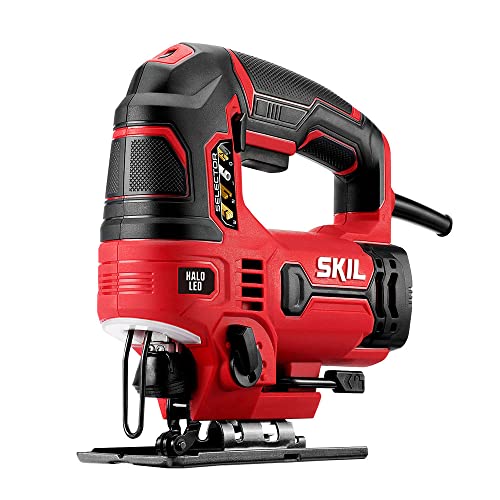
SKIL specifies the JS314901 with a 6A motor, 800–3,200 SPM, 7/8-inch stroke, four orbital settings, tool-free blade clamp, tool-free bevel adjustment, dust blower, and Halo Light. The manual lists wood sawing capacity at 3-3/8 inches.
For occasional hardwood projects, it provides the essential controls without moving into a premium price class. The main limitation is refinement under heavy continuous load compared with more expensive professional corded models.
- Best for: Best Hobby Corded Alternative where blade stiffness, speed/orbit control, shoe stability, and feed technique matter.
- Why we picked it: SKIL JS314901 fits a distinct hardwood workflow based on motor/platform, speed control, stroke, orbital settings, shoe rigidity, and blade guidance under dense-stock load.
- Key strengths: controlled stroke rate, stable shoe, secure T-shank clamping, and enough power/control to cut hardwood without forcing the saw.
- Important limitations: thick hardwood increases blade deflection, heat, and chip-clearance difficulty; maximum wood capacity is not a guarantee of square joinery-ready cuts.
- What to check before buying: hardwood-rated blade width/thickness/TPI, usable blade length, orbital setting, shoe square, speed range, stock thickness, feed pressure, and whether another saw is better for required squareness.
- Who should buy it: woodworkers making curves, cutouts, and moderate-thickness hardwood parts where jigsaw flexibility matters.
- Who should skip it: users needing repeated thick, perfectly square joinery cuts better handled by bandsaw, table saw, track saw, or another supported-blade process.
| ✅ Pros | ❌ Cons |
|---|---|
| • 6A corded motor • 800–3,200 SPM • Four orbital settings • Tool-free blade and bevel adjustments • 3-3/8 in. listed wood capacity | • Hobby-oriented platform • Dense hardwood may require slower feed and frequent blade changes |
Manufacturer specifications | View exact JS314901 on Amazon
8. RYOBI PBLJS01B — Best ONE+ HP Hardwood Option

RYOBI’s PBLJS01B is an 18V ONE+ HP brushless jigsaw with an 800–3,400 SPM variable-speed dial, four orbital settings, die-cast metal base, tool-free bevel adjustment, easy-release blade lever, LED work light, and a non-marring shoe.
It is most compelling for an existing ONE+ shop. The 3,400-SPM ceiling provides a broad adjustment range, but dense hardwood still rewards the lowest setting that cuts efficiently without burning or excessive deflection.
- Best for: Best ONE+ HP Hardwood Option where blade stiffness, speed/orbit control, shoe stability, and feed technique matter.
- Why we picked it: RYOBI PBLJS01B fits a distinct hardwood workflow based on motor/platform, speed control, stroke, orbital settings, shoe rigidity, and blade guidance under dense-stock load.
- Key strengths: controlled stroke rate, stable shoe, secure T-shank clamping, and enough power/control to cut hardwood without forcing the saw.
- Important limitations: thick hardwood increases blade deflection, heat, and chip-clearance difficulty; maximum wood capacity is not a guarantee of square joinery-ready cuts.
- What to check before buying: hardwood-rated blade width/thickness/TPI, usable blade length, orbital setting, shoe square, speed range, stock thickness, feed pressure, and whether another saw is better for required squareness.
- Who should buy it: woodworkers making curves, cutouts, and moderate-thickness hardwood parts where jigsaw flexibility matters.
- Who should skip it: users needing repeated thick, perfectly square joinery cuts better handled by bandsaw, table saw, track saw, or another supported-blade process.
| ✅ Pros | ❌ Cons |
|---|---|
| • Brushless ONE+ HP platform • 800–3,400 SPM • Four orbital settings • Die-cast base • Tool-free bevel • LED work light | • Battery/charger sold separately in tool-only package • Best value depends on existing ONE+ ownership |
Manufacturer specifications | View exact PBLJS01B/PBLJS01 on Amazon
9. Bosch JS260 — Best Lower-Cost Bosch Corded Pick

BOSCH JS260 120-Volt Top-Handle Jigsaw,Blue,6.0 Amp
The JS260 has a 6A motor, 500–3,100 SPM, 3/4-inch stroke, four orbital settings, heavy-gauge steel footplate, T-shank-only clamp, low-vibration plunging mechanism, and always-on blower. Bosch lists a 2-11/16-inch softwood capacity.
Its shorter 3/4-inch stroke makes it less aggressive than the 1-inch-stroke JS365/JS470E, but for moderate hardwood thickness and controlled cuts it remains a credible corded option.
- Best for: Best Lower-Cost Bosch Corded Pick where blade stiffness, speed/orbit control, shoe stability, and feed technique matter.
- Why we picked it: Bosch JS260 fits a distinct hardwood workflow based on motor/platform, speed control, stroke, orbital settings, shoe rigidity, and blade guidance under dense-stock load.
- Key strengths: controlled stroke rate, stable shoe, secure T-shank clamping, and enough power/control to cut hardwood without forcing the saw.
- Important limitations: thick hardwood increases blade deflection, heat, and chip-clearance difficulty; maximum wood capacity is not a guarantee of square joinery-ready cuts.
- What to check before buying: hardwood-rated blade width/thickness/TPI, usable blade length, orbital setting, shoe square, speed range, stock thickness, feed pressure, and whether another saw is better for required squareness.
- Who should buy it: woodworkers making curves, cutouts, and moderate-thickness hardwood parts where jigsaw flexibility matters.
- Who should skip it: users needing repeated thick, perfectly square joinery cuts better handled by bandsaw, table saw, track saw, or another supported-blade process.
| ✅ Pros | ❌ Cons |
|---|---|
| • 6A motor • 500–3,100 SPM • Low-vibration mechanism • Heavy-gauge footplate • T-shank blade clamp | • 3/4 in. stroke • Lower listed capacity than larger Bosch models • Always-on blower is less flexible with dust extraction |
Manufacturer specifications | View exact JS260 on Amazon
10. CRAFTSMAN CMCS600B — Best V20 Alternative

The CMCS600B is a V20 cordless jigsaw with 0–2,500 SPM variable speed, three orbital settings, bevel capability to 45°, dust blower, contoured grip, and compatibility with both T- and U-shank blades.
It is the logical choice for a woodworker already invested in V20 batteries. Its lower maximum SPM is not automatically a disadvantage in hardwood, where control and heat management can matter more than maximum blade speed.
- Best for: Best V20 Alternative where blade stiffness, speed/orbit control, shoe stability, and feed technique matter.
- Why we picked it: CRAFTSMAN CMCS600B fits a distinct hardwood workflow based on motor/platform, speed control, stroke, orbital settings, shoe rigidity, and blade guidance under dense-stock load.
- Key strengths: controlled stroke rate, stable shoe, secure T-shank clamping, and enough power/control to cut hardwood without forcing the saw.
- Important limitations: thick hardwood increases blade deflection, heat, and chip-clearance difficulty; maximum wood capacity is not a guarantee of square joinery-ready cuts.
- What to check before buying: hardwood-rated blade width/thickness/TPI, usable blade length, orbital setting, shoe square, speed range, stock thickness, feed pressure, and whether another saw is better for required squareness.
- Who should buy it: woodworkers making curves, cutouts, and moderate-thickness hardwood parts where jigsaw flexibility matters.
- Who should skip it: users needing repeated thick, perfectly square joinery cuts better handled by bandsaw, table saw, track saw, or another supported-blade process.
| ✅ Pros | ❌ Cons |
|---|---|
| • V20 battery platform • 0–2,500 SPM • Three orbital settings • 45° bevel • T- and U-shank compatibility | • Brushed/basic platform versus premium brushless options • Battery and charger sold separately |
Manufacturer specifications | View exact CMCS600B on Amazon
Choosing the Right Blade for Hardwood
The blade matters at least as much as the jigsaw. Choose a blade specifically rated for hardwood or dense wood and match its usable cutting length to the stock thickness. Tooth geometry, TPI, blade width, blade thickness, set, and steel/carbide construction all influence cut speed, chip clearance, finish, and deflection.
A very fine blade can leave a cleaner surface but may clear chips more slowly in thick hardwood. A coarse blade can cut faster but leave a rougher edge. For straight cuts where squareness matters, a thicker/wider blade designed to resist deflection is often more useful than a narrow scrolling blade.
Why Hardwood Cuts Burn
Burning is usually a process problem rather than proof that the jigsaw lacks power. Common causes include a dull blade, excessive feed pressure, too-fine teeth for thick stock, inadequate chip clearance, excessive speed for the blade/material combination, or steering pressure that twists the blade against the kerf.
If the cut begins to burn, stop and correct the cause. Continuing to force the blade increases heat and can worsen wandering.
Blade Deflection in Thick Hardwood
A jigsaw blade is supported from the top, so the bottom can lag behind the line even while the top appears accurate. The risk increases as stock gets thicker, the blade gets narrower or more flexible, the curve tightens, or feed pressure increases.
Keep the shoe flat, let the teeth cut at their own pace, avoid twisting the saw sideways, and inspect the underside when squareness matters. If a thick hardwood part must be square enough for joinery, a bandsaw, table saw, track saw, or another supported-blade process may be more appropriate.
Orbital Action in Hardwood
Orbital action moves the blade forward as well as up and down. This can speed cutting in wood but may increase tear-out and reduce control. For hardwood, start with straight/low orbital action unless the exact manufacturer recommends otherwise.
DEWALT is unusually explicit for the DW331: its manual says hardwood should not be cut in orbital action. Treat that as model-specific instruction and follow the manual for every other saw.
Hardwood vs. Hardwood Plywood
Solid hardwood and hardwood-faced plywood are different cutting problems. Solid hardwood emphasizes density, grain direction, heat, chip evacuation, and blade deflection. Plywood adds veneer tear-out and alternating grain layers. Tool Engineers keeps those intents separate; see the dedicated plywood jigsaw guide when sheet goods are the main material.
How Thick Is Too Thick for a Jigsaw?
A manufacturer’s maximum wood capacity is not the same as a guarantee of a square, furniture-ready hardwood cut at that thickness. As thickness increases, chip evacuation gets harder and the unsupported blade has more opportunity to bend.
Use a jigsaw for thick hardwood only when the required finish and squareness are realistic. For repeated thick parts or joinery-critical edges, use a tool with stronger blade support.
Corded vs. Cordless for Hardwood
Corded: continuous runtime, no battery sag/charging logistics, and often lower purchase cost for equivalent cutting capability.
Cordless: easier movement around large workpieces, no cord dragging across the cut line, and useful integration with an existing battery system.
Neither power source automatically makes a straighter hardwood cut. Blade quality, feed, shoe support, and operator steering remain the decisive factors.
Safety
Clamp the work securely, keep the shoe supported, and keep hands clear of the blade path and possible exit point. Disconnect power or remove the battery before changing blades or clearing jams as the manual instructs. A hot blade can burn skin, so use the tool’s ejection mechanism where provided and allow the blade to cool.
Do not force a bent, dull, cracked, or damaged blade through hardwood. Stop if the saw vibrates abnormally or the blade begins to bind.
Manufacturer References
- Bosch Tools, DEWALT, and Milwaukee Tool — jigsaw speed, stroke, orbital control, shoe, and blade-guidance specifications.
- Makita, SKIL, RYOBI, and CRAFTSMAN — current hardwood-capable jigsaw specifications and platform details.
FAQ
What is the best jigsaw for hardwood?
The Bosch JS470E is the strongest overall corded choice here because its 7A motor, 500–3,100 SPM control, 1-inch stroke, Constant Response circuitry, rigid footplate, and low-vibration plunging mechanism create a strong platform for controlled dense-wood cutting.
Is a cordless jigsaw powerful enough for hardwood?
Yes, current brushless models such as Milwaukee 2737-20, DEWALT DCS334B, Makita XVJ04Z, and RYOBI PBLJS01B are designed for demanding wood cutting. Use the correct blade and battery, and do not force the feed.
What blade should I use for oak or maple?
Use a sharp blade specifically rated for hardwood/dense wood and sized for the stock thickness and cut type. A wider, stiffer blade generally helps straight-cut squareness; a narrower blade turns tighter curves but is more prone to deflection.
Should I use orbital mode on hardwood?
Start with straight or low orbital action unless the exact manual says otherwise. DEWALT specifically instructs straight action for hardwood on the DW331.
Why is my jigsaw cut angled underneath?
The blade is deflecting. Common causes include thick stock, too much feed pressure, a flexible/dull blade, tight curves, or sideways steering pressure.
When should I use a bandsaw instead?
Use a bandsaw when the hardwood is thick, the part is repeated, the curve is long, or you need better blade support and more consistent squareness than a jigsaw can deliver.
Warranty, Value, and Availability
For hardwood-focused use, compare current manufacturer warranty, blade availability, battery cost where applicable, shoe/accessory support, and service access. The saw itself is only part of the cost; dense hardwood may consume premium blades faster when feed, speed, or orbital settings are wrong.
Related Tool Engineers Guides
For curve-heavy work, use Tool Engineers’ circle-cutting guide and barrel-grip vs. top-handle comparison.
Who Should Buy Which Jigsaw for Hardwood?
- Best corded control: Bosch JS470E/JS365/JS260.
- Existing 20V MAX user: DEWALT DCS334B.
- Existing M18 user: Milwaukee 2737-20.
- Existing LXT user: Makita XVJ04Z.
- Budget corded: SKIL JS314901.
- V20 user: CRAFTSMAN CMCS600B.
Final Verdict
The Bosch JS470E is the best all-around corded hardwood platform in this comparison because it combines speed control, a long stroke, rigid shoe, T-shank clamping, low-vibration guidance, and Constant Response under load.
For cordless users, choose by battery ecosystem: Milwaukee 2737-20 for M18, DEWALT DCS334B for 20V MAX, Makita XVJ04Z for LXT, or RYOBI PBLJS01B for ONE+ HP. For occasional corded hardwood work, the SKIL JS314901 and Bosch JS260 are simpler lower-cost alternatives.
Whichever saw you choose, hardwood results depend heavily on the blade and technique. Use a sharp hardwood-rated blade, keep the shoe planted, reduce feed pressure when the blade starts to wander, and choose another saw when the stock is too thick for the squareness you need.
