
As an Amazon Associate, Tool Engineers earns from qualifying purchases. Amazon prices and availability are accurate as of the date shown and are subject to change; verify the current listing before purchase.
The best table saw for a small shop is not automatically the smallest saw. A compact workshop needs a saw that can cut the stock you actually use, then get out of the way when it is time to assemble, route, sand, finish, or move material. That makes stored footprint, folding or rolling hardware, rip capacity per square foot, dust connection, fence usability, and the ability to share outfeed space more important than maximum capacity alone.
For most tight workshops, the DEWALT DWE7485 is the strongest compact bench/cart choice because DEWALT verifies a 24.5 in. rip capacity, 15A/5,800 RPM motor, rack-and-pinion fence, blade brake, power-loss reset, onboard storage, and an 8-1/4 in. format that is easier to integrate into a mobile cabinet than a full rolling 10 in. saw. If you want a saw with its own folding stand, the SKIL TS6307-00 is a better floor-space solution; if you need much more rip capacity, the Bosch GTS15-10 and DEWALT DWE7491RS trade more storage volume for 32+ in. capacity.
We did not perform original cut testing for this roundup. No fence-deflection, dust-capture, noise, vibration, or accuracy scores are invented. Manufacturer specifications are used for dimensions, capacity, motor data, safety systems, and included hardware.
Quick Picks
- Best compact bench/cart saw: DEWALT DWE7485 — 24.5 in. rip, compact 8-1/4 in. platform, rack-and-pinion fence.
- Best folding-stand value: SKIL TS6307-00 — 10 in. blade, 25.5 in. rip, integrated folding legs.
- Best high-capacity rolling setup: Bosch GTS15-10 — 32-1/8 in. rip, Gravity-Rise stand, 10 in. blade.
- Best DEWALT rolling setup: DWE7491RS — 32-1/2 in. rip, rolling stand, retracting fence rails.
- Best ultra-compact 8-1/4 in. alternative: SKIL TS6308-00 — 39.5 lb, 24.5 in. rip, 5/8 in. dado capacity.
- Best compact worm-drive option: SKILSAW SPT99T-01 — 44 lb, 25 in. rip, rack-and-pinion fence.
- Best cordless layout flexibility: Bosch GTS18V-08N — 18V PROFACTOR, 25 in. rip, 5,500 RPM.
- Best compact safety-system option: SawStop CTS-120A60 — 10 in. blade, 24.5 in. rip, contact-detection brake system.
- Best wide-rip fold-and-roll option: Metabo HPT C10RJS — 35 in. right rip, fold-and-roll stand, 19 x 20 x 28 in. upright storage dimensions.
- Best one-step rolling alternative: Delta 36-6023 — 32.5 in. rip, rack-and-pinion fence, one-step folding stand.
How We Chose Table Saws for Small Shops
- Stored footprint: the saw must have somewhere realistic to park when the floor is needed for another operation.
- Operating envelope: rip capacity matters only if there is room for infeed, outfeed, operator position, and a clear kickback path.
- Mobility: folding legs, wheels, single-hand carry, or a cart-friendly body can return floor space after a cut.
- Fence efficiency: rack-and-pinion or similarly repeatable adjustment helps when there is little room to walk around the machine.
- Dust routing: confined shops accumulate dust quickly, so a useful dust port and clean hose path matter.
- Capacity per footprint: we favored saws that provide useful rip/cut capacity without permanently occupying cabinet-saw space.
- Accessory storage: onboard storage prevents guards, push sticks, and wrenches from consuming separate bench space.
- Safety: riving knife, guard, anti-kickback devices, brakes, and stable stands remain essential even when space is tight.
Quick Comparison
| Model | Price | Blade / Power | Right Rip | Small-Shop Strength | Main Trade-Off |
|---|---|---|---|---|---|
| DEWALT DWE7485 | $429.00 | 8-1/4 in. / 15A | 24.5 in. | Compact cart/bench integration | Needs separate stand/cart |
| SKIL TS6307-00 | $299.00 | 10 in. / 15A | 25.5 in. | Integrated folding stand | Less rip than 32–35 in. saws |
| Bosch GTS15-10 | $649.00 | 10 in. / 15A | 32-1/8 in. | Gravity-Rise mobility + high capacity | 91 lb package |
| DEWALT DWE7491RS | — | 10 in. / 15A | 32.5 in. | Rolling stand + retracting rails | Larger parked footprint |
| SKIL TS6308-00 | $226.59 | 8-1/4 in. / 15A | 24.5 in. | 39.5 lb body + compact storage | Stand sold separately |
| SKILSAW SPT99T-01 | — | 8-1/4 in. / 15A | 25 in. | 44 lb worm-drive compact platform | Premium price for compact saw |
| Bosch GTS18V-08N | $469.00 | 8-1/4 in. / 18V | 25 in. | No floor cord + single-hand carry | Battery/charger cost and runtime |
| SawStop CTS-120A60 | $974.00 | 10 in. / 15A | 24.5 in. | Compact body + safety brake | No dado stack support |
| Metabo HPT C10RJS | — | 10 in. / 15A | 35 in. | Very wide rip + fold-and-roll storage | 100 lb assembled |
| Delta 36-6023 | — | 10 in. / 15A | 32.5 in. | One-step folding stand | 78 lb tool |
1. DEWALT DWE7485 — Best Compact Bench/Cart Platform

DEWALT’s DWE7485 is one of the easiest current table saws to design into a small-shop cart. The manufacturer specifies an 8-1/4 in. blade, 15A motor, 5,800 RPM, 24.5 in. right rip capacity, rack-and-pinion telescoping fence rails, blade brake, power-loss reset, non-through riving knife, guard, anti-kickback pawls, push stick, and onboard accessory storage.
The small-shop advantage is not merely portability. Because there is no permanently attached large rolling stand, the saw can be mounted at a height that matches an existing assembly/outfeed bench and stored above drawers or blade storage.
- Best for: Best Compact Bench/Cart Platform where stored footprint, operating envelope, mobility, dust routing, fence usability, and capacity-per-floor-area matter.
- Why we picked it: DEWALT DWE7485 fills a distinct compact-shop role based on bench/cart integration, folding or rolling storage, rip capacity, blade format, and how easily the floor can be reclaimed after use.
- Key strengths: useful capacity for its footprint, predictable fence control, practical storage/mobility, and compatibility with shared outfeed/assembly-space planning.
- Important limitations: body dimensions alone do not describe safe operating space; full sheets and long boards still need infeed/outfeed clearance and a clear kickback path.
- What to check before buying: stored dimensions, working footprint, rip width, blade depth, fence travel, stand/cart, dust port, dado approval, caster/stand locking, and shared-bench height.
- Who should buy it: woodworkers who must balance real table-saw capacity with a garage or compact-shop floor plan.
- Who should skip it: users buying maximum rip capacity they rarely use or expecting a tiny saw body to make full-sheet handling easy in a cramped room.
| ✅ Pros | ❌ Cons |
|---|---|
| • Compact 8-1/4 in. body • 24.5 in. rip capacity • Rack-and-pinion fence • Blade brake + power-loss reset • Onboard storage • Easy to integrate into a custom mobile cart | • Stand/cart is a separate decision • Smaller blade reduces depth versus 10 in. saws • Do not assume stacked-dado compatibility without exact manual approval |
DEWALT specifications | View exact DWE7485 on Amazon
2. SKIL TS6307-00 — Best Integrated Folding-Stand Workflow

The TS6307-00 combines a 10 in. blade, 15A motor, rack-and-pinion fence, integrated folding legs, 25.5 in. right rip, parallel blade alignment, and 4×4 cutting capacity in a platform that can be folded rather than permanently occupying a bench.
That stand design is especially useful in a one-car garage or basement shop where the same floor area may serve as cutting station in the morning and assembly space later.
- Best for: Best Integrated Folding-Stand Workflow where stored footprint, operating envelope, mobility, dust routing, fence usability, and capacity-per-floor-area matter.
- Why we picked it: SKIL TS6307-00 fills a distinct compact-shop role based on bench/cart integration, folding or rolling storage, rip capacity, blade format, and how easily the floor can be reclaimed after use.
- Key strengths: useful capacity for its footprint, predictable fence control, practical storage/mobility, and compatibility with shared outfeed/assembly-space planning.
- Important limitations: body dimensions alone do not describe safe operating space; full sheets and long boards still need infeed/outfeed clearance and a clear kickback path.
- What to check before buying: stored dimensions, working footprint, rip width, blade depth, fence travel, stand/cart, dust port, dado approval, caster/stand locking, and shared-bench height.
- Who should buy it: woodworkers who must balance real table-saw capacity with a garage or compact-shop floor plan.
- Who should skip it: users buying maximum rip capacity they rarely use or expecting a tiny saw body to make full-sheet handling easy in a cramped room.
| ✅ Pros | ❌ Cons |
|---|---|
| • Integrated folding stand • 10 in. blade • Rack-and-pinion fence • 25.5 in. rip • No separate cart required | • Smaller rip than Bosch/DEWALT/Metabo HPT large rolling saws • Folded saw still needs a planned parking location |
SKIL specifications | View exact TS6307-00 on Amazon
3. Bosch GTS15-10 — Best High-Capacity Rolling Small-Shop Setup

BOSCH GTS15-10 10 Inch Portable Jobsite Table Saw with Rise Wheeled Stand
Bosch specifies a 10 in. blade, 15A motor, 3,800 RPM, 32-1/8 in. right rip, 3-9/16 in. depth at 90°, rack-and-pinion fence, soft start, electronic speed regulation, Smart Guard system, and a Gravity-Rise wheeled stand. Total listed weight is 91 lb.
The GTS15-10 earns its place in a small shop because its stand can move the saw between a cutting aisle and a parking position. Bosch also offers a TS1015 outfeed support that extends 14 in. and stores flush to the table—useful where a permanent standalone outfeed table is impossible.
- Best for: Best High-Capacity Rolling Small-Shop Setup where stored footprint, operating envelope, mobility, dust routing, fence usability, and capacity-per-floor-area matter.
- Why we picked it: Bosch GTS15-10 fills a distinct compact-shop role based on bench/cart integration, folding or rolling storage, rip capacity, blade format, and how easily the floor can be reclaimed after use.
- Key strengths: useful capacity for its footprint, predictable fence control, practical storage/mobility, and compatibility with shared outfeed/assembly-space planning.
- Important limitations: body dimensions alone do not describe safe operating space; full sheets and long boards still need infeed/outfeed clearance and a clear kickback path.
- What to check before buying: stored dimensions, working footprint, rip width, blade depth, fence travel, stand/cart, dust port, dado approval, caster/stand locking, and shared-bench height.
- Who should buy it: woodworkers who must balance real table-saw capacity with a garage or compact-shop floor plan.
- Who should skip it: users buying maximum rip capacity they rarely use or expecting a tiny saw body to make full-sheet handling easy in a cramped room.
| ✅ Pros | ❌ Cons |
|---|---|
| • 32-1/8 in. right rip • Gravity-Rise wheeled stand • Rack-and-pinion fence • Soft start + electronic speed regulation • Flush-stowing optional outfeed support | • 91 lb total package • Large saw still needs long infeed/outfeed clearance • Costs more space than compact 8-1/4 in. saws |
Bosch specifications | View exact GTS15-10 on Amazon
4. DEWALT DWE7491RS — Best DEWALT Rolling Setup

DEWALT’s DWE7491RS uses a 10 in. blade, 15A motor, 32-1/2 in. rip capacity, rack-and-pinion telescoping fence, 3-1/8 in. depth at 90°, onboard accessory storage, and a rolling stand designed for fast setup and breakdown. The telescoping fence rails retract to reduce the stored package.
For a compact workshop that regularly handles shelving, larger panels, or wider casework, the added capacity may justify the larger parked footprint. If your normal parts are under 24 in. wide, the DWE7485 is easier to accommodate.
- Best for: Best DEWALT Rolling Setup where stored footprint, operating envelope, mobility, dust routing, fence usability, and capacity-per-floor-area matter.
- Why we picked it: DEWALT DWE7491RS fills a distinct compact-shop role based on bench/cart integration, folding or rolling storage, rip capacity, blade format, and how easily the floor can be reclaimed after use.
- Key strengths: useful capacity for its footprint, predictable fence control, practical storage/mobility, and compatibility with shared outfeed/assembly-space planning.
- Important limitations: body dimensions alone do not describe safe operating space; full sheets and long boards still need infeed/outfeed clearance and a clear kickback path.
- What to check before buying: stored dimensions, working footprint, rip width, blade depth, fence travel, stand/cart, dust port, dado approval, caster/stand locking, and shared-bench height.
- Who should buy it: woodworkers who must balance real table-saw capacity with a garage or compact-shop floor plan.
- Who should skip it: users buying maximum rip capacity they rarely use or expecting a tiny saw body to make full-sheet handling easy in a cramped room.
| ✅ Pros | ❌ Cons |
|---|---|
| • 32-1/2 in. right rip • Rolling stand included • Retracting rack-and-pinion fence rails • Onboard accessory storage • 10 in. blade ecosystem | • Larger footprint than compact saws • Extra capacity is wasted if your work rarely needs it |
DEWALT specifications | View exact DWE7491RS on Amazon
5. SKIL TS6308-00 — Best Ultra-Compact Corded Alternative

SKIL 15 Amp 8-1/4-Inch Compact Portable Jobsite Table Saw (Stand SFS0001 Sold Separately)-TS6308-00
The newer TS6308-00 uses an 8-1/4 in. blade and SKIL lists a 15A motor, 5,000 RPM, 24.5 in. right rip, 2.5 in. cut depth at 90°, 5/8 in. maximum dado width, rack-and-pinion fence, 2-1/2 in. dust-hose support, and a 39.5 lb tool weight. The table is approximately 21.5 x 18 in.
That combination is very small-shop friendly: it provides a full 24.5 in. rip capacity without an attached stand. SKIL’s SFS0001 folding stand is optional, so you can choose between benchtop/cart integration or a fold-away stand.
- Best for: Best Ultra-Compact Corded Alternative where stored footprint, operating envelope, mobility, dust routing, fence usability, and capacity-per-floor-area matter.
- Why we picked it: SKIL TS6308-00 fills a distinct compact-shop role based on bench/cart integration, folding or rolling storage, rip capacity, blade format, and how easily the floor can be reclaimed after use.
- Key strengths: useful capacity for its footprint, predictable fence control, practical storage/mobility, and compatibility with shared outfeed/assembly-space planning.
- Important limitations: body dimensions alone do not describe safe operating space; full sheets and long boards still need infeed/outfeed clearance and a clear kickback path.
- What to check before buying: stored dimensions, working footprint, rip width, blade depth, fence travel, stand/cart, dust port, dado approval, caster/stand locking, and shared-bench height.
- Who should buy it: woodworkers who must balance real table-saw capacity with a garage or compact-shop floor plan.
- Who should skip it: users buying maximum rip capacity they rarely use or expecting a tiny saw body to make full-sheet handling easy in a cramped room.
| ✅ Pros | ❌ Cons |
|---|---|
| • 39.5 lb compact body • 24.5 in. rip • Rack-and-pinion fence • 5/8 in. manufacturer-listed dado capacity • 2-1/2 in. dust connection | • Stand sold separately • 8-1/4 in. blade limits maximum depth |
SKIL specifications | View exact TS6308-00 on Amazon
6. SKILSAW SPT99T-01 — Best Compact Worm-Drive Option
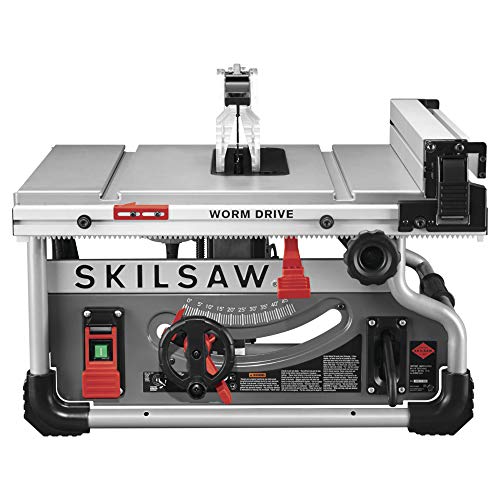
The SPT99T-01 is an 8-1/4 in. portable worm-drive table saw with a 15A Dual-Field motor, 5,300 RPM, 25 in. right rip, 2-5/8 in. cut depth at 90°, 1/2 in. dado capacity, rack-and-pinion fence, and a manufacturer-listed 44 lb weight. SKIL lists body dimensions around 21.5 in. deep, 23.5 in. wide, and 13 in. high.
Its main small-shop benefit is fitting worm-drive gearing into a compact body that can be stored on a shelf or cart. A separate folding stand is available when floor setup is preferred.
- Best for: Best Compact Worm-Drive Option where stored footprint, operating envelope, mobility, dust routing, fence usability, and capacity-per-floor-area matter.
- Why we picked it: SKILSAW SPT99T-01 fills a distinct compact-shop role based on bench/cart integration, folding or rolling storage, rip capacity, blade format, and how easily the floor can be reclaimed after use.
- Key strengths: useful capacity for its footprint, predictable fence control, practical storage/mobility, and compatibility with shared outfeed/assembly-space planning.
- Important limitations: body dimensions alone do not describe safe operating space; full sheets and long boards still need infeed/outfeed clearance and a clear kickback path.
- What to check before buying: stored dimensions, working footprint, rip width, blade depth, fence travel, stand/cart, dust port, dado approval, caster/stand locking, and shared-bench height.
- Who should buy it: woodworkers who must balance real table-saw capacity with a garage or compact-shop floor plan.
- Who should skip it: users buying maximum rip capacity they rarely use or expecting a tiny saw body to make full-sheet handling easy in a cramped room.
| ✅ Pros | ❌ Cons |
|---|---|
| • 44 lb compact body • 25 in. rip • Rack-and-pinion fence • Worm-drive gearing • 1/2 in. dado capacity | • Premium price • Stand is separate • 8-1/4 in. depth limits versus full 10 in. saws |
SKILSAW specifications | View exact SPT99T-01 on Amazon
7. Bosch GTS18V-08N — Best Cordless Layout Flexibility

The GTS18V-08N is Bosch’s PROFACTOR 18V 8-1/4 in. portable table saw. Bosch specifies BITURBO brushless technology, 5,500 RPM, 25 in. right rip, rack-and-pinion fence adjustment, single-hand carry design, onboard storage, and restart protection. The bare-tool model requires a compatible high-output CORE18V battery for the intended PROFACTOR performance.
In a small shop, cordless does not mean “more powerful”; it means layout flexibility. Removing an extension cord from the floor can simplify a mobile setup, especially when the saw moves between several working positions.
- Best for: Best Cordless Layout Flexibility where stored footprint, operating envelope, mobility, dust routing, fence usability, and capacity-per-floor-area matter.
- Why we picked it: Bosch GTS18V-08N fills a distinct compact-shop role based on bench/cart integration, folding or rolling storage, rip capacity, blade format, and how easily the floor can be reclaimed after use.
- Key strengths: useful capacity for its footprint, predictable fence control, practical storage/mobility, and compatibility with shared outfeed/assembly-space planning.
- Important limitations: body dimensions alone do not describe safe operating space; full sheets and long boards still need infeed/outfeed clearance and a clear kickback path.
- What to check before buying: stored dimensions, working footprint, rip width, blade depth, fence travel, stand/cart, dust port, dado approval, caster/stand locking, and shared-bench height.
- Who should buy it: woodworkers who must balance real table-saw capacity with a garage or compact-shop floor plan.
- Who should skip it: users buying maximum rip capacity they rarely use or expecting a tiny saw body to make full-sheet handling easy in a cramped room.
| ✅ Pros | ❌ Cons |
|---|---|
| • Cordless 18V PROFACTOR platform • 5,500 RPM • 25 in. rip • Rack-and-pinion fence • Single-hand carry design | • Battery/charger cost • Runtime depends on battery and workload • Battery charging creates another storage/utility requirement |
Bosch platform specifications | View exact GTS18V-08N bare tool on Amazon
8. SawStop CTS-120A60 — Best Compact Safety-System Option

The SawStop Compact Table Saw combines a 10 in. blade, 15A direct-drive motor, 4,000 RPM, 24.5 in. right rip, rack-and-pinion fence, standard-width miter slot, 2-1/2 in. dust port, and SawStop’s contact-detection blade-brake system. The listed saw body is roughly 27 x 23.5 x 14.1 in. and about 68–79 lb depending on configuration/source.
The key small-shop limitation is dado capability: SawStop states that the CTS does not support dado stacks. If cabinet joinery with a stacked dado is central to your shop, choose another platform rather than assuming every 10 in. saw can accept one.
- Best for: Best Compact Safety-System Option where stored footprint, operating envelope, mobility, dust routing, fence usability, and capacity-per-floor-area matter.
- Why we picked it: SawStop CTS-120A60 fills a distinct compact-shop role based on bench/cart integration, folding or rolling storage, rip capacity, blade format, and how easily the floor can be reclaimed after use.
- Key strengths: useful capacity for its footprint, predictable fence control, practical storage/mobility, and compatibility with shared outfeed/assembly-space planning.
- Important limitations: body dimensions alone do not describe safe operating space; full sheets and long boards still need infeed/outfeed clearance and a clear kickback path.
- What to check before buying: stored dimensions, working footprint, rip width, blade depth, fence travel, stand/cart, dust port, dado approval, caster/stand locking, and shared-bench height.
- Who should buy it: woodworkers who must balance real table-saw capacity with a garage or compact-shop floor plan.
- Who should skip it: users buying maximum rip capacity they rarely use or expecting a tiny saw body to make full-sheet handling easy in a cramped room.
| ✅ Pros | ❌ Cons |
|---|---|
| • Compact 10 in. platform • Contact-detection safety brake • Rack-and-pinion fence • 24.5 in. rip • 2-1/2 in. dust port | • No dado stack support • Higher purchase cost • Heavier than some compact 8-1/4 in. saws |
SawStop specifications | View exact CTS-120A60 on Amazon
9. Metabo HPT C10RJS — Best Wide-Rip Fold-and-Roll Option

Metabo HPT 10-Inch Table Saw 15-Amp Fold and Roll Stand Power Saw, C10RJS
Metabo HPT specifies a 10 in. blade, 15A/4,500 RPM motor, 35 in. right rip, 22 in. left rip, 28-3/4 x 22 in. table, rack-and-pinion fence, 13/16 in. dado capacity, soft start, electric brake, 2-1/2 in. dust port, and a fold-and-roll stand. Assembled weight is about 100 lb.
The standout small-shop specification is the upright storage size: Metabo HPT lists approximately 19 x 20 x 28 in. when stored upright. That can make a surprisingly high-capacity saw workable in a shop where a permanent 35 in. rip table would be impossible.
- Best for: Best Wide-Rip Fold-and-Roll Option where stored footprint, operating envelope, mobility, dust routing, fence usability, and capacity-per-floor-area matter.
- Why we picked it: Metabo HPT C10RJS fills a distinct compact-shop role based on bench/cart integration, folding or rolling storage, rip capacity, blade format, and how easily the floor can be reclaimed after use.
- Key strengths: useful capacity for its footprint, predictable fence control, practical storage/mobility, and compatibility with shared outfeed/assembly-space planning.
- Important limitations: body dimensions alone do not describe safe operating space; full sheets and long boards still need infeed/outfeed clearance and a clear kickback path.
- What to check before buying: stored dimensions, working footprint, rip width, blade depth, fence travel, stand/cart, dust port, dado approval, caster/stand locking, and shared-bench height.
- Who should buy it: woodworkers who must balance real table-saw capacity with a garage or compact-shop floor plan.
- Who should skip it: users buying maximum rip capacity they rarely use or expecting a tiny saw body to make full-sheet handling easy in a cramped room.
| ✅ Pros | ❌ Cons |
|---|---|
| • 35 in. right rip • Fold-and-roll stand • Compact upright storage dimensions • Rack-and-pinion fence • 13/16 in. dado capacity • Soft start + electric brake | • 100 lb assembled • Needs a clear rolling/storage path • High capacity still requires long workpiece clearance |
Metabo HPT specifications | View exact C10RJS on Amazon
- Best for: Best One-Step Folding Alternative where stored footprint, operating envelope, mobility, dust routing, fence usability, and capacity-per-floor-area matter.
- Why we picked it: Delta 36-6023 fills a distinct compact-shop role based on bench/cart integration, folding or rolling storage, rip capacity, blade format, and how easily the floor can be reclaimed after use.
- Key strengths: useful capacity for its footprint, predictable fence control, practical storage/mobility, and compatibility with shared outfeed/assembly-space planning.
- Important limitations: body dimensions alone do not describe safe operating space; full sheets and long boards still need infeed/outfeed clearance and a clear kickback path.
- What to check before buying: stored dimensions, working footprint, rip width, blade depth, fence travel, stand/cart, dust port, dado approval, caster/stand locking, and shared-bench height.
- Who should buy it: woodworkers who must balance real table-saw capacity with a garage or compact-shop floor plan.
- Who should skip it: users buying maximum rip capacity they rarely use or expecting a tiny saw body to make full-sheet handling easy in a cramped room.
10. Delta 36-6023 — Best One-Step Folding Alternative
Delta’s 36-6023 uses a 10 in. blade, 15A motor, up to 5,000 RPM, 32.5 in. right rip, 22.5 in. left rip, rack-and-pinion fence, 13/16 x 8 in. stacked-dado capacity, 2-1/2 in. dust port, and a one-step folding rolling stand. Delta lists the tool at about 78 lb.
This is a strong small-shop choice when you want more than 30 in. of rip capacity but prefer a simple one-step fold rather than designing a custom cart.
| ✅ Pros | ❌ Cons |
|---|---|
| • 32.5 in. right rip • One-step folding stand • Rack-and-pinion fence • 13/16 in. dado capacity • 2-1/2 in. dust port | • 78 lb • Operating footprint is much larger than compact 8-1/4 in. saws |
Delta specifications | View exact 36-6023 on Amazon
Design the Shop Around the Operating Envelope
A saw’s body dimensions describe storage, not safe operation. Mark the operator position, likely kickback path, infeed length, outfeed length, and fence extension. A 24 in. wide saw can still require an eight-foot aisle to rip a long board.
In a small shop, the same aisle can serve several machines as long as only one is operating at a time. Mobile bases and folding stands let you rotate tools into that shared lane.
Use One Surface for More Than One Job
A compact shop becomes more efficient when the table-saw outfeed, assembly table, and sometimes router-table support are planned around compatible heights. A mobile cart under a compact saw can hold blades, push sticks, jigs, and dust fittings while an adjacent bench supplies outfeed support.
Do not let a shared bench interfere with guard movement, motor ventilation, fence rails, bevel controls, or blade height adjustments.
Breaking Down Full Sheets
Even a saw with 32–35 in. rip capacity may be a poor first tool for a full 4×8 sheet in a tiny room. A track saw or guided circular saw can break sheet goods into smaller blanks; the table saw can then bring those pieces to repeatable final width.
This reduces the amount of clear floor area needed around the table saw and lowers the risk of a large panel levering against the fence.
Dust Collection in a Small Shop
Confined rooms accumulate fine dust quickly. Connect the manufacturer’s dust port to an appropriate shop vacuum or extractor, route the hose so it does not pull on a mobile saw, and keep the floor clear of chips that can interfere with wheels and locking casters.
A 2-1/2 in. dust port is convenient, but port size alone does not determine collection quality. Internal shrouding, airflow, blade position, cut type, hose restriction, and leaks all matter.
Mobile Cart vs. Folding Stand vs. Rolling Stand
Custom mobile cart: best when you want drawers, blade storage, and a fixed relationship to an assembly/outfeed table. Folding stand: best when the saw must disappear into a narrow storage area. Rolling stand: best when the saw moves often and setup speed matters.
The right choice depends on your room and workflow rather than one universally superior stand type.
Small-Shop Safety
- Keep the kickback path clear even when the room is crowded.
- Lock wheels/casters before cutting.
- Use a riving knife, blade guard, and anti-kickback devices when required for the operation.
- Never make freehand table-saw cuts.
- Support long stock instead of allowing it to lever the workpiece off the table.
- Keep power cords and dust hoses out of the operator path.
- Do not block emergency exits, doors, or electrical panels with a parked saw.
- Disconnect power or remove the battery before blade/guard service when the manual instructs.
Who Should Buy Which Saw?
- Small shop with a custom cart/bench: DEWALT DWE7485 or SKIL TS6308-00.
- Need a built-in fold-away stand: SKIL TS6307-00.
- Need 32+ in. rip and fast mobility: Bosch GTS15-10 or DEWALT DWE7491RS.
- Want compact worm-drive architecture: SKILSAW SPT99T-01.
- Want no floor cord: Bosch GTS18V-08N.
- Safety brake is the priority: SawStop CTS.
- Need maximum rip but still vertical storage: Metabo HPT C10RJS.
- Want a one-step rolling stand: Delta 36-6023.
Manufacturer References
- DEWALT, SKIL / SKILSAW, and Bosch Tools — stored/working dimensions, rip capacity, fence, stand, and mobility specifications.
- SawStop, Metabo HPT, and Delta Machinery — table-saw safety, dado, dust-port, fold/roll, and storage specifications.
FAQ
What is the best table saw for a small shop?
The DEWALT DWE7485 is the most flexible compact choice because its 24.5 in. rip, rack-and-pinion fence, onboard storage, and small 8-1/4 in. body are easy to integrate into a mobile cabinet or shared-height bench. If you want a complete folding-floor setup, the SKIL TS6307-00 is easier.
Is an 8-1/4 inch table saw enough for woodworking?
For many small-shop projects, yes. The trade-off is reduced maximum depth versus a 10 in. saw. Rip capacity and actual stock thickness matter more than blade diameter alone.
Should I buy a folding table saw or build a cart?
Choose a folding stand when floor space must be fully reclaimed. Build a cart when you can park the saw against a wall and want storage plus a fixed height that works with an outfeed/assembly bench.
Is a 32-inch rip capacity necessary in a small shop?
No. Many users can break large panels down first and finish them on a 24–25 in. saw. Buy 32–35 in. capacity only when wider final cuts are common enough to justify the larger saw.
Is cordless better for a small shop?
It can improve layout flexibility and remove an extension cord from the floor. Corded saws avoid battery cost and charging. Neither is automatically better for cut quality.
Can I use my assembly table as outfeed?
Yes, if the height, clearance, and workpiece path are correct. The bench must not interfere with fence movement, guarding, controls, or the operator’s safe position.
Which compact saw supports dadoes?
SKIL lists up to 5/8 in. dado capacity on the TS6308-00 and TS6307-00 family documentation, while SKILSAW lists 1/2 in. on the SPT99T-01. Bosch GTS15-10, Metabo HPT C10RJS, and Delta 36-6023 support wider dado setups. SawStop states that the CTS does not support dado stacks.
Warranty, Value, and Availability
Compare current manufacturer warranty, stand cost, blade/accessory ecosystem, dado compatibility, and service access. A small-shop saw that needs an expensive custom stand or incompatible dust solution can cost more than a larger complete package.
Related Tool Engineers Guides
See Tool Engineers’ table-saw guide, sled plans, and blade-cleaning guide.
Final Verdict
The DEWALT DWE7485 is the best fit for most small shops because it packs a useful 24.5 in. rip capacity and rack-and-pinion fence into a compact body that can be built into a mobile storage cart. The SKIL TS6307-00 is better when you want the stand included and need the saw to fold away after every session.
If your projects genuinely require more than 30 in. of rip width, step up to the Bosch GTS15-10, DEWALT DWE7491RS, Metabo HPT C10RJS, or Delta 36-6023. If electrical-cord management is the problem, the Bosch GTS18V-08N is the cleanest layout solution. Choose the SawStop CTS when its contact-detection brake is a higher priority than dado capability.
In a compact workshop, optimize the room—not just the saw. The best setup is the one that provides the capacity you need, then gives the floor back when the cut is finished.
