
As an Amazon Associate, Tool Engineers earns from qualifying purchases. Amazon prices and availability are accurate as of the date shown and are subject to change; verify the current listing before purchase.
The best angle grinder disc for cutting metal must match the grinder and the workpiece: wheel diameter, thickness, arbor/mount, maximum RPM, abrasive type, material rating, and guard configuration all matter. This page is about the consumable cut-off wheel, not the grinder itself.
For a simple conventional 4-1/2 in. steel-cutting wheel, the DEWALT DW8062B5 is the strongest mainstream pick. For bulk fabrication, Benchmark Abrasives 4.5 in. Type 1 and the SALI 50-pack provide larger quantities. For a premium ceramic option, the 3M Cubitron II 33467 is the standout.
We did not perform original wheel-life or cutting-speed tests. Never side-load a thin cut-off wheel, exceed its rated speed, or use an incompatible guard/flange.
Quick Comparison
| Wheel | Price | Exact ASIN | Best Fit |
|---|---|---|---|
| DEWALT DW8062B5 5-pack | $5.97 | B005B8LZCI | Mainstream 4-1/2 in. metal cutting |
| DEWALT DW8062 10-pack | $18.91 | B006ERQD2M | More of the same proven format |
| SALI 50-pack 4-1/2 in. | $24.99 | B09DYQD55R | Bulk steel/stainless cutting |
| Benchmark Abrasives 50-pack | $34.64 | B015VOMD5E | Bulk fabrication |
| 3M Cubitron II 33467 | $79.99 | B07GTFLJF4 | Premium ceramic abrasive |
| Makita B-46159-25 | $56.04 | B0199RA4UU | Ultra-thin 4-1/2 in. cutting |
| FOXBC 50-pack | $34.82 | B0FC3P959T | Bulk metal/stainless use |
| FOXBC multi-material 3-pack | $14.99 | B0DZ29RG8X | Multi-material cutting |
| 4-1/2 in. 10-pack, 13,300 RPM | $6.98 | B0FH3WQXLB | Low-cost general metal use |
| 4-1/2 in. 50-pack thin wheels | $24.99 | B08FR63K33 | Bulk general metal use |
How We Chose Metal Cut-Off Wheels
- Correct wheel type: cutting wheels only, not grinding wheels.
- Diameter/arbor: must fit the grinder exactly.
- Maximum RPM: wheel rating must meet or exceed the grinder’s applicable speed.
- Material rating: steel/stainless use only when the exact wheel says so.
- Thickness: thin kerf improves cutting efficiency but increases sensitivity to side loading.
- Pack size: bulk packs only add value when the wheel spec itself is right.
1. DEWALT DW8062B5 — Best Overall Conventional Wheel

4-1/2 x .045 x 7/8 in. Type 1 cut-off wheel, sold as a 5-pack.
- Best for: Best Overall Conventional Wheel when the wheel diameter, thickness, arbor, maximum RPM, and guard match the grinder.
- Why we picked it: DEWALT DW8062B5 fills a distinct cut-off-wheel role based on abrasive type, wheel thickness, pack size, and intended metal-cutting workload.
- Key strengths: Purpose-built cut-off format, thin controlled kerf, and a specification set suited to metal separation rather than side grinding.
- Important limitations: Thin cut-off wheels must not be side-loaded; wheel damage, overspeed, wrong flanges, or the wrong guard can cause failure.
- What to check before buying: Diameter, thickness, Type 1/27 format, arbor/mount, max RPM, ferrous/stainless suitability, grinder guard, and flange compatibility.
- Who should buy it: Users doing repeated metal cutting with a grinder specifically approved for this wheel format.
- Who should skip it: Users intending to grind with the wheel face, remove the guard, exceed wheel RPM, or cut a material not listed for the wheel.
| ✅ Pros | ❌ Cons |
|---|---|
| • Designed specifically for metal cut-off work • Thin kerf helps reduce material removal • Useful fit for standard angle-grinder cutting workflows when specifications match | • Not for side grinding • Compatibility must be checked against the exact grinder and guard |
2. DEWALT DW8062 10-Pack — Best Larger DEWALT Pack
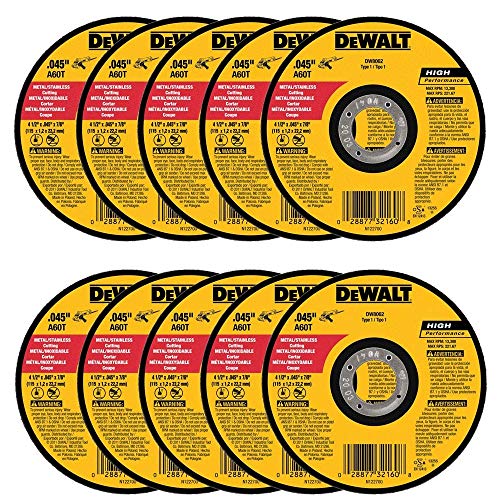
Same thin-wheel format in a larger pack for users who consume this size regularly.
- Best for: Best Larger DEWALT Pack when the wheel diameter, thickness, arbor, maximum RPM, and guard match the grinder.
- Why we picked it: DEWALT DW8062 10-Pack fills a distinct cut-off-wheel role based on abrasive type, wheel thickness, pack size, and intended metal-cutting workload.
- Key strengths: Purpose-built cut-off format, thin controlled kerf, and a specification set suited to metal separation rather than side grinding.
- Important limitations: Thin cut-off wheels must not be side-loaded; wheel damage, overspeed, wrong flanges, or the wrong guard can cause failure.
- What to check before buying: Diameter, thickness, Type 1/27 format, arbor/mount, max RPM, ferrous/stainless suitability, grinder guard, and flange compatibility.
- Who should buy it: Users doing repeated metal cutting with a grinder specifically approved for this wheel format.
- Who should skip it: Users intending to grind with the wheel face, remove the guard, exceed wheel RPM, or cut a material not listed for the wheel.
| ✅ Pros | ❌ Cons |
|---|---|
| • Designed specifically for metal cut-off work • Thin kerf helps reduce material removal • Useful fit for standard angle-grinder cutting workflows when specifications match | • Not for side grinding • Compatibility must be checked against the exact grinder and guard |
3. SALI 50-Pack — Best Bulk Steel/Stainless Option

4-1/2 x 3/64 x 7/8 in. bulk wheels intended for metal and stainless applications per the exact listing.
- Best for: Best Bulk Steel/Stainless Option when the wheel diameter, thickness, arbor, maximum RPM, and guard match the grinder.
- Why we picked it: SALI 50-Pack fills a distinct cut-off-wheel role based on abrasive type, wheel thickness, pack size, and intended metal-cutting workload.
- Key strengths: Purpose-built cut-off format, thin controlled kerf, and a specification set suited to metal separation rather than side grinding.
- Important limitations: Thin cut-off wheels must not be side-loaded; wheel damage, overspeed, wrong flanges, or the wrong guard can cause failure.
- What to check before buying: Diameter, thickness, Type 1/27 format, arbor/mount, max RPM, ferrous/stainless suitability, grinder guard, and flange compatibility.
- Who should buy it: Users doing repeated metal cutting with a grinder specifically approved for this wheel format.
- Who should skip it: Users intending to grind with the wheel face, remove the guard, exceed wheel RPM, or cut a material not listed for the wheel.
| ✅ Pros | ❌ Cons |
|---|---|
| • Designed specifically for metal cut-off work • Thin kerf helps reduce material removal • Useful fit for standard angle-grinder cutting workflows when specifications match | • Not for side grinding • Compatibility must be checked against the exact grinder and guard |
4. Benchmark Abrasives 50-Pack — Best Bulk Fabrication Pick

4.5 in. aluminum-oxide Type 1 wheels with 7/8 in. arbor for metal/stainless cutting.
- Best for: Best Bulk Fabrication Pick when the wheel diameter, thickness, arbor, maximum RPM, and guard match the grinder.
- Why we picked it: Benchmark Abrasives 50-Pack fills a distinct cut-off-wheel role based on abrasive type, wheel thickness, pack size, and intended metal-cutting workload.
- Key strengths: Purpose-built cut-off format, thin controlled kerf, and a specification set suited to metal separation rather than side grinding.
- Important limitations: Thin cut-off wheels must not be side-loaded; wheel damage, overspeed, wrong flanges, or the wrong guard can cause failure.
- What to check before buying: Diameter, thickness, Type 1/27 format, arbor/mount, max RPM, ferrous/stainless suitability, grinder guard, and flange compatibility.
- Who should buy it: Users doing repeated metal cutting with a grinder specifically approved for this wheel format.
- Who should skip it: Users intending to grind with the wheel face, remove the guard, exceed wheel RPM, or cut a material not listed for the wheel.
| ✅ Pros | ❌ Cons |
|---|---|
| • Designed specifically for metal cut-off work • Thin kerf helps reduce material removal • Useful fit for standard angle-grinder cutting workflows when specifications match | • Not for side grinding • Compatibility must be checked against the exact grinder and guard |
5. 3M Cubitron II 33467 — Best Premium Ceramic Wheel

3M Cubitron II Cut-Off Wheel 33467, High Performance, Fast Cutting, Long Lasting, 4-1/2 in x 0.04 in x 7/8 in, 5 Wheels/Carton
4.5 x .04 x 7/8 in. Cubitron II cut-off wheel with ceramic abrasive technology.
- Best for: Best Premium Ceramic Wheel when the wheel diameter, thickness, arbor, maximum RPM, and guard match the grinder.
- Why we picked it: 3M Cubitron II 33467 fills a distinct cut-off-wheel role based on abrasive type, wheel thickness, pack size, and intended metal-cutting workload.
- Key strengths: Purpose-built cut-off format, thin controlled kerf, and a specification set suited to metal separation rather than side grinding.
- Important limitations: Thin cut-off wheels must not be side-loaded; wheel damage, overspeed, wrong flanges, or the wrong guard can cause failure.
- What to check before buying: Diameter, thickness, Type 1/27 format, arbor/mount, max RPM, ferrous/stainless suitability, grinder guard, and flange compatibility.
- Who should buy it: Users doing repeated metal cutting with a grinder specifically approved for this wheel format.
- Who should skip it: Users intending to grind with the wheel face, remove the guard, exceed wheel RPM, or cut a material not listed for the wheel.
| ✅ Pros | ❌ Cons |
|---|---|
| • Designed specifically for metal cut-off work • Thin kerf helps reduce material removal • Useful fit for standard angle-grinder cutting workflows when specifications match | • Not for side grinding • Compatibility must be checked against the exact grinder and guard |
6. Makita B-46159-25 — Best Ultra-Thin Makita Pack

4-1/2 in. ultra-thin cut-off wheel pack for compatible grinders.
- Best for: Best Ultra-Thin Makita Pack when the wheel diameter, thickness, arbor, maximum RPM, and guard match the grinder.
- Why we picked it: Makita B-46159-25 fills a distinct cut-off-wheel role based on abrasive type, wheel thickness, pack size, and intended metal-cutting workload.
- Key strengths: Purpose-built cut-off format, thin controlled kerf, and a specification set suited to metal separation rather than side grinding.
- Important limitations: Thin cut-off wheels must not be side-loaded; wheel damage, overspeed, wrong flanges, or the wrong guard can cause failure.
- What to check before buying: Diameter, thickness, Type 1/27 format, arbor/mount, max RPM, ferrous/stainless suitability, grinder guard, and flange compatibility.
- Who should buy it: Users doing repeated metal cutting with a grinder specifically approved for this wheel format.
- Who should skip it: Users intending to grind with the wheel face, remove the guard, exceed wheel RPM, or cut a material not listed for the wheel.
| ✅ Pros | ❌ Cons |
|---|---|
| • Designed specifically for metal cut-off work • Thin kerf helps reduce material removal • Useful fit for standard angle-grinder cutting workflows when specifications match | • Not for side grinding • Compatibility must be checked against the exact grinder and guard |
7. FOXBC 50-Pack — Best High-Quantity Alternative

FOXBC 4-1/2 Inch Cut Off Wheel Discs for Angle Grinder, Cutting for Metal & Stainless Steel, 4-1/2" x .045" x 7/8" - 50 Pack
4-1/2 x .045 x 7/8 in. cut-off wheels for metal/stainless use.
- Best for: Best High-Quantity Alternative when the wheel diameter, thickness, arbor, maximum RPM, and guard match the grinder.
- Why we picked it: FOXBC 50-Pack fills a distinct cut-off-wheel role based on abrasive type, wheel thickness, pack size, and intended metal-cutting workload.
- Key strengths: Purpose-built cut-off format, thin controlled kerf, and a specification set suited to metal separation rather than side grinding.
- Important limitations: Thin cut-off wheels must not be side-loaded; wheel damage, overspeed, wrong flanges, or the wrong guard can cause failure.
- What to check before buying: Diameter, thickness, Type 1/27 format, arbor/mount, max RPM, ferrous/stainless suitability, grinder guard, and flange compatibility.
- Who should buy it: Users doing repeated metal cutting with a grinder specifically approved for this wheel format.
- Who should skip it: Users intending to grind with the wheel face, remove the guard, exceed wheel RPM, or cut a material not listed for the wheel.
| ✅ Pros | ❌ Cons |
|---|---|
| • Designed specifically for metal cut-off work • Thin kerf helps reduce material removal • Useful fit for standard angle-grinder cutting workflows when specifications match | • Not for side grinding • Compatibility must be checked against the exact grinder and guard |
8. FOXBC Multi-Material 3-Pack — Best Multi-Material Alternative

Use only where the exact listing and grinder approve the material and operating speed.
- Best for: Best Multi-Material Alternative when the wheel diameter, thickness, arbor, maximum RPM, and guard match the grinder.
- Why we picked it: FOXBC Multi-Material 3-Pack fills a distinct cut-off-wheel role based on abrasive type, wheel thickness, pack size, and intended metal-cutting workload.
- Key strengths: Purpose-built cut-off format, thin controlled kerf, and a specification set suited to metal separation rather than side grinding.
- Important limitations: Thin cut-off wheels must not be side-loaded; wheel damage, overspeed, wrong flanges, or the wrong guard can cause failure.
- What to check before buying: Diameter, thickness, Type 1/27 format, arbor/mount, max RPM, ferrous/stainless suitability, grinder guard, and flange compatibility.
- Who should buy it: Users doing repeated metal cutting with a grinder specifically approved for this wheel format.
- Who should skip it: Users intending to grind with the wheel face, remove the guard, exceed wheel RPM, or cut a material not listed for the wheel.
| ✅ Pros | ❌ Cons |
|---|---|
| • Designed specifically for metal cut-off work • Thin kerf helps reduce material removal • Useful fit for standard angle-grinder cutting workflows when specifications match | • Not for side grinding • Compatibility must be checked against the exact grinder and guard |
9. 4-1/2 in. 10-Pack — Best Low-Cost General Option

Thin wheels listed for metal/stainless with a stated 13,300 RPM maximum; verify the exact tool/wheel match before mounting.
- Best for: Best Low-Cost General Option when the wheel diameter, thickness, arbor, maximum RPM, and guard match the grinder.
- Why we picked it: 4-1/2 in. 10-Pack fills a distinct cut-off-wheel role based on abrasive type, wheel thickness, pack size, and intended metal-cutting workload.
- Key strengths: Purpose-built cut-off format, thin controlled kerf, and a specification set suited to metal separation rather than side grinding.
- Important limitations: Thin cut-off wheels must not be side-loaded; wheel damage, overspeed, wrong flanges, or the wrong guard can cause failure.
- What to check before buying: Diameter, thickness, Type 1/27 format, arbor/mount, max RPM, ferrous/stainless suitability, grinder guard, and flange compatibility.
- Who should buy it: Users doing repeated metal cutting with a grinder specifically approved for this wheel format.
- Who should skip it: Users intending to grind with the wheel face, remove the guard, exceed wheel RPM, or cut a material not listed for the wheel.
| ✅ Pros | ❌ Cons |
|---|---|
| • Designed specifically for metal cut-off work • Thin kerf helps reduce material removal • Useful fit for standard angle-grinder cutting workflows when specifications match | • Not for side grinding • Compatibility must be checked against the exact grinder and guard |
10. 4-1/2 in. 50-Pack Thin Wheels — Bulk Alternative

Another bulk format for users who need many conventional thin cut-off wheels.
- Best for: Bulk Alternative when the wheel diameter, thickness, arbor, maximum RPM, and guard match the grinder.
- Why we picked it: 4-1/2 in. 50-Pack Thin Wheels fills a distinct cut-off-wheel role based on abrasive type, wheel thickness, pack size, and intended metal-cutting workload.
- Key strengths: Purpose-built cut-off format, thin controlled kerf, and a specification set suited to metal separation rather than side grinding.
- Important limitations: Thin cut-off wheels must not be side-loaded; wheel damage, overspeed, wrong flanges, or the wrong guard can cause failure.
- What to check before buying: Diameter, thickness, Type 1/27 format, arbor/mount, max RPM, ferrous/stainless suitability, grinder guard, and flange compatibility.
- Who should buy it: Users doing repeated metal cutting with a grinder specifically approved for this wheel format.
- Who should skip it: Users intending to grind with the wheel face, remove the guard, exceed wheel RPM, or cut a material not listed for the wheel.
| ✅ Pros | ❌ Cons |
|---|---|
| • Designed specifically for metal cut-off work • Thin kerf helps reduce material removal • Useful fit for standard angle-grinder cutting workflows when specifications match | • Not for side grinding • Compatibility must be checked against the exact grinder and guard |
Cut-Off Wheel vs. Grinding Wheel
A thin cut-off wheel is primarily loaded radially for cutting. A grinding wheel is designed for a different loading direction. Never side-grind with a thin wheel unless the exact manufacturer explicitly permits it.
Diameter, Arbor and RPM
All must match. Never remove a guard to gain clearance, install an oversized wheel, or use a wheel rated below the tool’s speed.
Stainless/Inox
Use a wheel specifically rated for stainless/Inox when contamination control matters; do not infer stainless suitability from a generic “metal” label.
Safety
Inspect every wheel before mounting, clamp the work, use the correct cutting guard and side handle, wear suitable PPE, keep sparks away from combustibles, and stay out of the wheel plane where practical.
Full-Depth Product Decision Notes
Cut-off wheels are safety-critical consumables. The exact wheel—not just the brand—must match material, diameter, arbor/mount, thickness, maximum RPM, wheel type, and guard/flange system.
DEWALT DW8062B5 — Detailed Fit
Pros: familiar 4-1/2 in. thin-wheel format, mainstream availability. Cons: thin wheels are sensitive to twisting/side load. Buy if: you need a conventional wheel for compatible general metal cutting.
DEWALT DW8062 10-Pack — Detailed Fit
Pros: same general format with larger quantity. Cons: pack size adds no technical advantage. Buy if: you already know this wheel spec fits your grinder and work.
SALI 50-Pack — Detailed Fit
Pros: bulk quantity and thin kerf. Cons: a large pack is wasteful if the application/material rating is wrong. Buy if: repeated compatible fabrication justifies volume.
Benchmark Abrasives 50-Pack — Detailed Fit
Pros: bulk fabrication format and conventional arbor. Cons: requires careful material/RPM verification. Buy if: shop consumption is high.
3M Cubitron II 33467 — Detailed Fit
Pros: premium ceramic abrasive technology and thin kerf. Cons: premium price. Buy if: professional fabrication justifies a premium consumable.
Makita B-46159-25 — Detailed Fit
Pros: ultra-thin 4-1/2 in. format. Cons: thin wheels demand disciplined straight cutting. Buy if: low-kerf compatible cutting is the goal.
FOXBC 50-Pack — Detailed Fit
Pros: large quantity. Cons: marketplace bulk consumables require close verification of the exact listing and rating. Buy if: the exact spec matches your material and grinder.
FOXBC Multi-Material 3-Pack — Detailed Fit
Pros: smaller quantity and broader material intent. Cons: multi-material wording does not override tool/wheel limits. Buy if: the exact supported materials match your work.
4-1/2 in. 10-Pack — Detailed Fit
Pros: low-cost pack. Cons: lesser-known products should be judged strictly by printed dimensions, standard, material rating, and maximum RPM. Buy if: documentation is clear and compliant.
4-1/2 in. 50-Pack Thin Wheels — Detailed Fit
Pros: high quantity for routine metal cutting. Cons: quality consistency and documentation matter more than unit price. Buy if: the exact product is verified for the intended material.
Included Contents and Storage
Cut-off wheel “kits” usually include only wheels. Store them dry, flat/protected as the manufacturer specifies, and discard wheels with chips, cracks, distortion, moisture damage, or questionable history.
Performance: Kerf, Wheel Life, and Cut Quality
Thinner wheels can cut with less material removal, but they are less tolerant of lateral load. Wheel life depends on material, pressure, wheel composition, speed, cut depth, and operator technique; retailer review counts are not technical evidence.
Who Should Buy Which Type?
- General occasional cutting: DEWALT 5/10-pack.
- Professional premium abrasive: 3M Cubitron II.
- High-volume fabrication: Benchmark or SALI bulk packs.
- Low-kerf specialty need: Makita ultra-thin format.
Warranty, Value, and Availability
Abrasive wheels are consumables, so value should be judged by verified specification, safe performance, and cost per usable cut—not power-tool-style warranty expectations. Check current lot/product documentation before buying bulk.
Alternatives
If the job requires side grinding, use an appropriate grinding wheel. If the job is repeated high-volume cutting, a chop saw, band saw, cold saw, or purpose-built cut-off machine may be a better tool than an angle grinder.
Related Tool Engineers Guides
For disc selection by task, see Angle Grinder Blade Types Guide. For safe accessory changes, see How to Change a Blade on an Angle Grinder.
Manufacturer References
- DEWALT, 3M Abrasives, and Makita — cut-off wheel dimensions, abrasive type, RPM limits, and metal-cutting specifications.
- Benchmark Abrasives and Mercer Industries — metal cut-off wheel specifications and application guidance.
FAQ
Can I use a grinding wheel to cut metal?
Use a wheel specifically designed and rated for cutting. Grinding wheels and thin cut-off wheels are built for different loading directions.
Can a metal cut-off wheel cut stainless?
Only when the exact wheel is rated for stainless/Inox and meets the contamination-control needs of the job.
Can I use a larger wheel by removing the guard?
No. Use only the wheel sizes and guard/flange configurations approved for the grinder.
What matters more than pack size?
Material rating, wheel type, diameter, arbor, thickness, maximum RPM, and consistent safe manufacturing quality.
Final Verdict
The DEWALT DW8062B5 is the strongest mainstream conventional pick; choose 3M Cubitron II for a premium abrasive or Benchmark/SALI when verified bulk quantity matters.
