
If you have ever watched two metal sheets join in a flash of heat and pressure, you have already seen resistance spot welding in action. It looks simple from the outside. Two copper arms touch the metal, current passes through, and a small weld nugget forms in a fraction of a second. But there is smart science behind that quick moment.
So, how does a spot welder work? The short answer is this: it uses electrical resistance to create heat right where two pieces of metal touch, then presses them together until they fuse. No flame. No filler rod. Just controlled current, force, and timing.
This guide explains the process in clear, simple language. You will learn what happens inside the metal, what parts make the machine work, how the weld is formed, and what mistakes people often make. If you want a practical understanding of how does a spot welder work, this article will give you a solid one.
The basic idea behind resistance spot welding
Resistance spot welding is one of the most common welding methods in factories. It is used a lot in car bodies, appliances, metal cabinets, battery tabs, and sheet metal products. The reason is simple: it is fast, repeatable, and strong enough for thin metal parts.
The core idea is based on electrical resistance. When electric current passes through metal, the metal resists that flow a little bit. That resistance turns electrical energy into heat. In spot welding, the heat is concentrated at the point where two metal sheets meet. That is where the weld forms.
The machine does not try to melt the whole sheet. It only makes a tiny molten spot, then squeezes it until it cools and hardens. That small welded point is called a weld nugget.
According to the American Welding Society, resistance welding is widely used because it offers high production speed and good consistency in suitable applications.
Why the heat forms at the joint
The heat does not spread evenly through the whole metal piece. It builds mostly at the contact area for a few reasons:
- The contact between the two sheets is not perfect, so resistance is higher there.
- The pressure from the electrodes creates a small contact zone.
- The current path is concentrated through that tiny area.
This is one of the first things beginners miss. They think the metal heats because it is “powered” by electricity. In truth, the heat comes from resistance at a narrow point. That is why spot welding can be so precise.
The main parts of a spot welder
A spot welder may look like a simple machine, but each part has a clear job. If one part is weak or poorly adjusted, the weld quality drops quickly.
| Part | What it does | Why it matters |
|---|---|---|
| Power source | Supplies high current for a very short time | Creates the heat needed for welding |
| Transformer | Steps down voltage and increases current | Provides the strong current used in spot welding |
| Electrodes | Carry current and apply pressure | Focus the weld at the joint |
| Control unit | Sets timing, current, and squeeze force | Helps make each weld repeatable |
| Arm or frame | Holds the electrodes in place | Keeps alignment stable |
| Cooling system | Removes heat from the electrodes and machine | Prevents damage and extends tool life |
Electrodes are more than simple metal tips
The electrodes are usually made from copper alloys because copper carries current very well. But they must also survive heat and pressure. So manufacturers use materials that balance conductivity, strength, and wear resistance.
Here is a useful detail many beginners overlook: electrode shape matters almost as much as current settings. A flat, clean tip gives a different weld than a worn or rounded one. As the tip wears, the contact area changes, and the weld becomes less stable.
What happens during one spot weld
The full welding cycle happens in a few short stages. The process is very fast, but each stage has a purpose.
- Squeeze — The electrodes press the metal sheets together with force.
- Weld current — A very high current flows through the sheets for a short time.
- Heat build-up — Resistance at the joint creates intense heat.
- Fusion — The metal at the contact point melts and forms a small pool.
- Hold — The electrodes keep pressure on the joint while the nugget cools.
- Release — The electrodes open after the weld solidifies.
That last hold step is easy to ignore, but it is very important. If the pressure is released too early, the hot weld can crack or distort. The metal needs a moment to freeze under pressure.
Why time matters so much
Spot welding is a balance of three things: current, time, and force. Change one, and you change the weld.
- Too little current may create a weak or incomplete weld.
- Too much current can burn through the metal or cause spatter.
- Too little time may not form a proper nugget.
- Too much time can overheat the material and damage the sheets.
- Poor force control can reduce contact quality or squeeze molten metal out of place.
The second non-obvious insight is this: good spot welding is not just about “more power.” In many cases, the best weld is made by using the right pressure and the right short pulse, not the highest possible current. More power can actually make the weld worse.
How the weld nugget forms
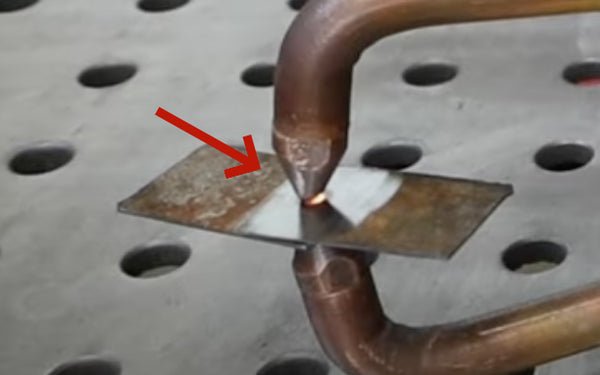
The weld nugget is the small fused area that holds the sheets together. It forms at the exact point where resistance and pressure are concentrated.
At first, the metal warms up. Then it softens. Then a tiny molten zone appears. The metal around it stays cooler because the electrodes pull heat away. When the current stops, the molten zone solidifies while the pressure is still holding the sheets together.
The result is a strong spot bond with a round weld nugget inside the joint.
Credit: yeswelder.com
Why the nugget is usually hidden
In spot welding, the strongest part of the joint is inside the sheets. You often cannot see it from the outside. On the surface, you may only see two small electrode marks. That is normal. A good weld is not always pretty, but it should be stable and consistent.
Weld size depends on the material type, sheet thickness, current, and electrode condition. For very thin sheet metal, the nugget is small. For thicker materials, the process must be carefully adjusted or it will fail.
Why spot welding works well for thin metal
Spot welding is especially useful for thin sheets because they heat quickly and cool quickly. That makes them easier to join in a controlled way.
It is also good for high-volume work. A machine can make many welds in a short time, which is why it is so common in assembly lines.
Here are a few reasons manufacturers like it:
- Fast cycle time
- Easy automation
- Low need for filler metal
- Clean process with little smoke
- Repeatable results when set up correctly
But spot welding is not universal. It works best when the sheets are close together, clean, and suitable for the machine’s current range. Very thick metal, dirty surfaces, and poor joint fit can cause trouble.
The role of pressure in the process
Many people focus only on electricity, but pressure is just as important. The electrodes must press the metal firmly enough to make good contact, but not so hard that they damage the joint.
Pressure helps in several ways:
- It keeps the sheets aligned.
- It improves electrical contact at the joint.
- It controls the shape of the molten zone.
- It helps the weld cool in the right form.
If pressure is too low, the current path becomes unstable. If pressure is too high, the sheets may deform and the weld nugget may become too small. Good welding is a careful balance, not a force contest.
What happens if pressure is wrong
Wrong pressure creates common defects. Low pressure can cause expulsion, which means molten metal gets squeezed out of the joint. High pressure can leave a weak weld because the contact area becomes too large and heat is spread too thinly.
This is another point beginners often miss. A weak spot weld is not always caused by low current. Sometimes the real problem is pressure, surface condition, or electrode wear.
Materials that can be spot welded
Spot welding works best on metals that conduct electricity and heat in a predictable way. It is widely used on low-carbon steel. It also works on stainless steel, coated steel, nickel, and some aluminum applications, though aluminum can be more difficult.
Different metals behave differently:
- Low-carbon steel is easy to spot weld and gives reliable results.
- Stainless steel needs careful heat control because it holds heat longer.
- Aluminum needs high current and clean surfaces because it conducts heat very fast.
- Coated metals may need special settings because the coating changes resistance.
Surface condition matters a lot. Dirt, rust, oil, paint, and oxide layers all change the resistance at the joint. Sometimes that can help a little, but often it causes unstable welds. Clean contact is usually the safer choice.
How a spot welder is used in practice
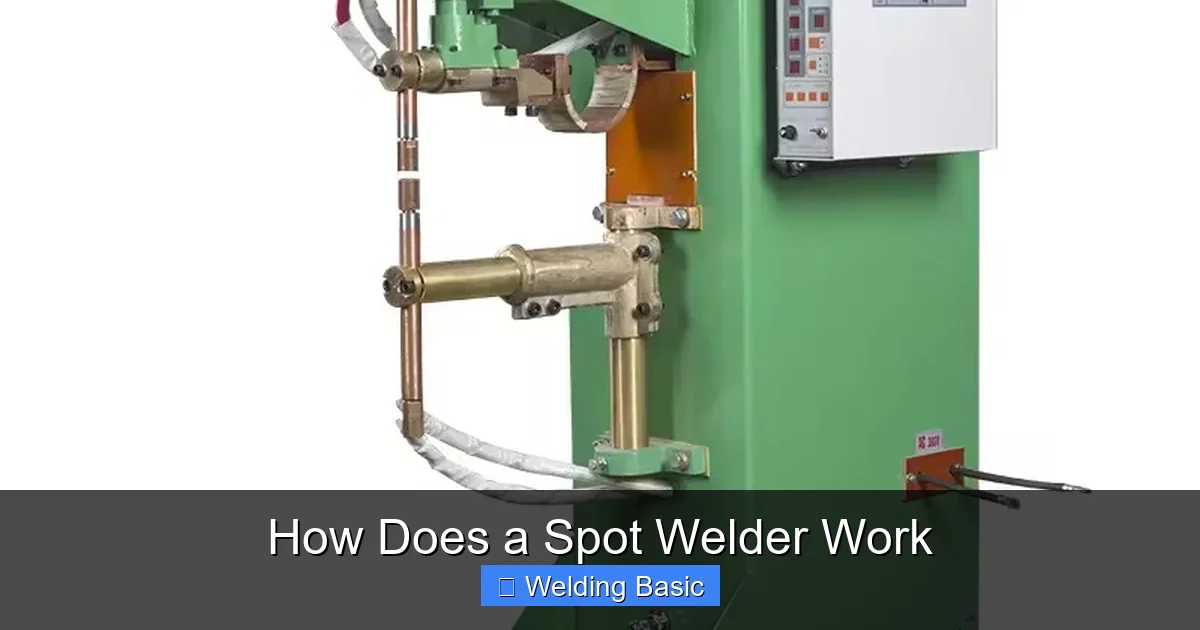
A basic spot welding job starts with the operator placing two sheets between the electrodes. The machine closes the electrodes and applies force. Then the controller sends current for a set time. After that, the electrodes stay in place briefly while the metal cools.
In production settings, these settings are often stored in programs. That helps the machine repeat the same weld many times. In manual work, the operator must pay close attention to electrode condition, alignment, and sound.
Good operators listen and watch the process. A stable weld often has a clean cycle with no harsh sparks, no excessive squeeze-out, and no visible damage around the spot.
Credit: weldmastery.com
Signs of a healthy weld
You may not always see the nugget, but you can still look for signs of quality:
- Even electrode marks
- No burn-through
- No major spatter
- Strong hold between sheets
- Consistent spot size across the joint
In some jobs, weld tests are done by peel testing or destructive testing. That means the joint is pulled apart to see how the nugget formed. It may seem harsh, but it is one of the best ways to confirm weld quality.
Common mistakes that weaken spot welds
Spot welding looks easy, but small errors can ruin the joint. Here are the most common ones.
- Dirty surfaces — Oil, rust, and paint change resistance and reduce consistency.
- Worn electrodes — A damaged tip changes the contact area and distorts the weld.
- Wrong current setting — Too low gives weak fusion, too high causes spatter or burn-through.
- Poor sheet fit-up — Gaps between sheets make the weld unstable.
- Incorrect timing — A short pulse may not heat enough; a long one may overheat the joint.
One smart habit is to think of the joint as a system. If the weld is bad, do not assume the current is the only issue. Check the surface, force, electrode tip, and part fit too.
Spot welding versus other welding methods
Spot welding is different from arc welding methods like MIG or TIG. In arc welding, a continuous arc melts the metal along a seam. In spot welding, the machine creates a small welded point at a time.
This makes spot welding better for overlap joints in sheet metal. It is not the right choice when you need a long continuous seam or a visible bead on the outside.
Here is a simple way to think about it:
- Spot welding is best for fast joining of thin overlapping sheets.
- MIG welding is useful for faster manual welding with filler wire.
- TIG welding gives high control and clean welds, but takes more time.
Each process has its place. Spot welding is not “better” in every case. It is simply the best fit for many thin-sheet production jobs.
Why the process is so widely used in factories
Factories like spot welding because it supports speed and consistency. A robot or machine can repeat the same motion thousands of times. That is hard to do with many other welding methods.
It also works well with assembly lines. Parts can move from one station to the next quickly, and the weld time is very short. That makes spot welding ideal for mass production.
Another advantage is cleanliness. Since there is no filler rod or long arc, the process often creates less smoke and less visible mess than some other welding methods.
How to think about quality in spot welding
If you want to understand how does a spot welder work in a useful way, think beyond the machine itself. Good weld quality comes from a system of four things:
- Current must be high enough to create heat.
- Time must be short and controlled.
- Force must hold the joint in the right shape.
- Surface condition must allow stable contact.
When those four parts work together, the weld is more likely to be strong and repeatable. If one part is off, the result becomes less reliable.
A simple mental picture
Imagine two sheets of metal being sandwiched by two copper tips. The machine sends a burst of current through the sandwich. The tight contact point gets hot first. That tiny hot point turns into a molten dot. The machine holds pressure until the dot freezes. That is the whole idea, in simple form.
It sounds easy, but the settings behind that moment matter a lot. The art of spot welding is finding the exact balance that makes the nugget strong without damaging the sheet.
Practical tips for better spot welds
Whether you are learning, maintaining a machine, or checking weld quality, these tips can help:
- Keep electrode tips clean and shaped correctly.
- Make sure the metal sheets fit tightly before welding.
- Remove oil, rust, and heavy dirt from the joint area.
- Use the correct settings for the metal type and thickness.
- Watch for signs of overheating, such as spatter or burn marks.
- Check cooling, especially during long production runs.
Here is a non-obvious tip that matters a lot: if the machine is making good welds at the start but weaker welds later, heat buildup may be the hidden problem. Electrode and machine temperature can slowly change performance over time.
Credit: weldmastery.com
Final thought
So, how does a spot welder work? It uses controlled electric current, pressure, and time to create heat at the contact point between two metal sheets. That heat forms a small molten nugget, and the pressure holds it in place until it cools into a strong bond.
The process is simple in concept, but the quality depends on the details. Current, force, timing, surface cleanliness, and electrode condition all matter. Once you understand those parts, spot welding stops looking like a mystery and starts looking like a very smart manufacturing tool.
FAQs
1. How does a spot welder work in one sentence?
A spot welder sends high current through two pressed metal sheets so resistance creates heat at the joint, forming a small fused nugget.
2. Why are copper electrodes used in spot welding?
Copper carries current very well and also helps remove heat, so the electrodes can focus welding energy at the joint while staying durable.
3. Can a spot welder join thick metal?
Usually, spot welders are best for thin sheet metal. Thick metal needs much more current and force, so the process becomes less practical.
4. What makes a bad spot weld?
Bad spot welds often come from dirty surfaces, worn electrodes, wrong current settings, poor pressure, or bad timing.
5. Is spot welding stronger than regular welding?
Not always. Spot welding is strong for the right type of joint, especially overlapping sheet metal, but it is not the best choice for every welding job.
