
Buying or replacing a pressure washer hose, gun, wand, or nozzle should be simple. But many people get stuck at the connection point. The parts look close, yet they do not fit. Threads do not match. One adapter is too large. Another leaks after one minute of use.
That is why understanding pressure washer connector types matters. The connector is the small part that decides whether your machine works smoothly or becomes a source of leaks, frustration, and wasted money. If you know the common sizes, thread styles, and fitting shapes, you can match parts faster and avoid buying the wrong accessory.
This guide explains the main connector types in clear language. You will learn what fits what, how to check thread size, and how to avoid the most common compatibility mistakes. By the end, you will know how to choose the right parts with more confidence.
Quick compatibility map before you buy
Match the connector by its job in the system, not by looks alone. A fitting that works at the water inlet may be wrong for the high-pressure hose, gun, wand, or nozzle side.
| Connection point | What to identify | Common mismatch to avoid |
|---|---|---|
| Water inlet | Garden hose thread or brand-specific inlet fitting | Using a low-pressure inlet fitting on the high-pressure side |
| Pump outlet to hose | M22 size, quick-connect size, thread standard, seal style, and pressure rating | Buying M22 by name without checking the 14 mm or 15 mm inner insert |
| Hose to trigger gun | Threaded or quick-connect end, inner size, O-ring/washer, and gun rating | Assuming both hose ends use the same connector |
| Gun to wand/lance | Brand interface, threaded collar, or quick-connect style | Mixing a proprietary gun or lance with a universal accessory without the correct adapter |
| Wand to nozzle or foam cannon | Usually 1/4-inch quick-connect, but verify plug/socket style and pressure rating | Matching the plug shape while ignoring PSI/GPM limits |
Why connector compatibility matters more than most buyers think
A pressure washer uses high water pressure. That means even a small mismatch can become a big problem. A loose connection may leak. A wrong thread may strip. A weak adapter may fail under pressure. In some cases, the washer still works, but performance drops because water escapes before it reaches the nozzle.
Many beginners think all pressure washer fittings are almost the same. They are not. Some systems use quick-connect ends. Others use threaded ends. Some brands mix both styles. The machine side and accessory side may also use different thread standards. If you do not check the exact connector type, you can end up with parts that almost fit but do not lock properly.
One useful habit is to identify the connector before buying anything else. Do not start with the hose length or spray pattern. Start with the fitting. That small step saves time and prevents returns.
The main pressure washer connector types you will see
Most pressure washer connector types fall into a few common groups. Once you understand these, the rest becomes much easier.
Quick-connect fittings
Quick-connect fittings are very common on modern pressure washers and accessories. They use a plug-and-socket style design. You push the plug into the socket, and it locks in place. To disconnect, you pull back the collar or sleeve.
These fittings are popular because they are fast and easy to use. They also help reduce wear from repeated twisting. Many users prefer quick-connect ends for spray wands, nozzles, and hose ends.
However, not every quick-connect part fits every other quick-connect part. Diameter and design still matter. A 1/4-inch quick-connect fitting is common for nozzles, while other accessories may use different sizes. The outside may look similar, but the inner opening and seal are not always the same.
Threaded fittings
Threaded fittings screw together. They are common on pumps, hoses, guns, and some machine inlets. The thread pattern must match exactly. If it does not, the parts may feel close for a moment, but they will not seal well.
The most common threaded styles in pressure washers are based on NPT or metric standards, depending on region and brand. Threaded fittings are reliable, but they require more care during matching. Cross-threading can damage both parts.
A good rule is to thread parts by hand first. If it does not turn easily, stop. Never force it.
M22 fittings
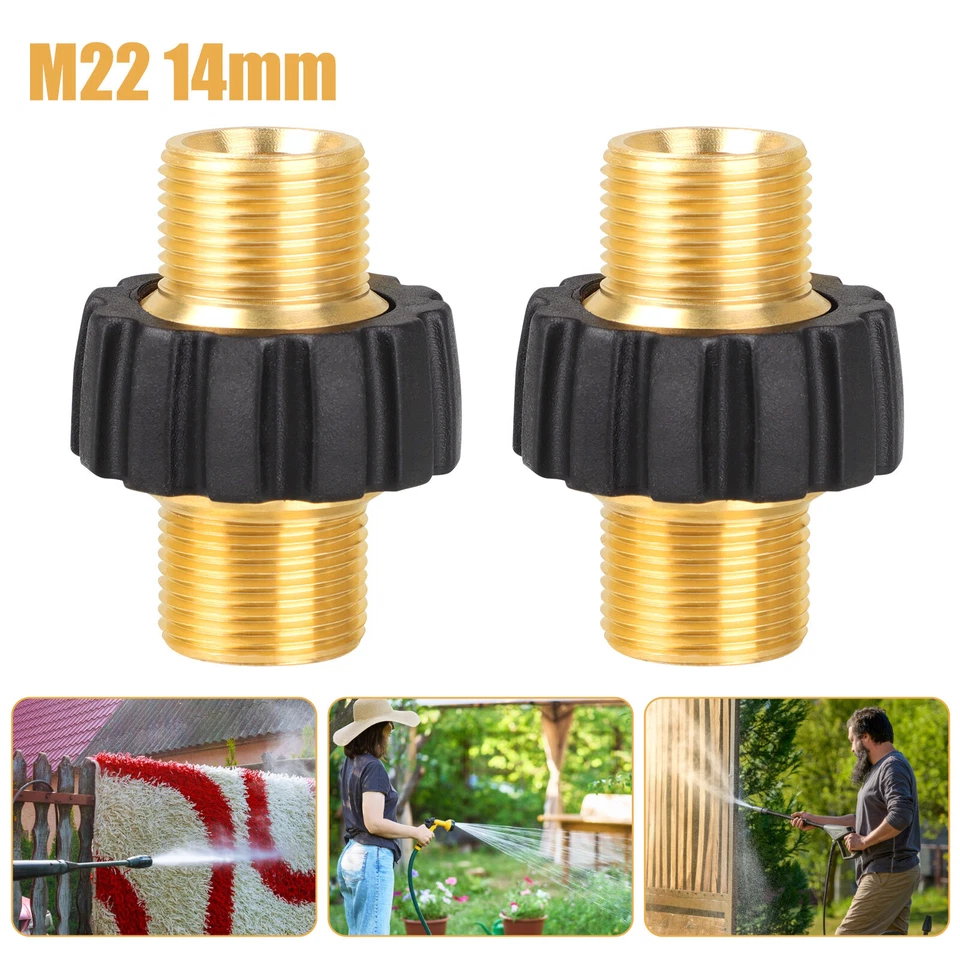
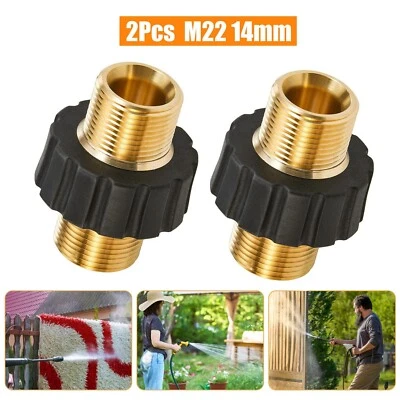
M22 fittings are very common on pressure washers, especially on hoses and trigger guns. The “M22” name refers to the thread size, but there is an important detail many buyers miss: not all M22 fittings are identical inside.
Two popular versions are often discussed as M22-14 and M22-15. The number after the dash usually refers to the inner diameter of the fitting. These can look almost the same from the outside, but they do not always connect properly with each other.
This is one of the biggest compatibility traps in pressure washer connector types. A part may say M22, but the inner insert still needs to match the hose or gun exactly.
1/4-inch quick-connect fittings
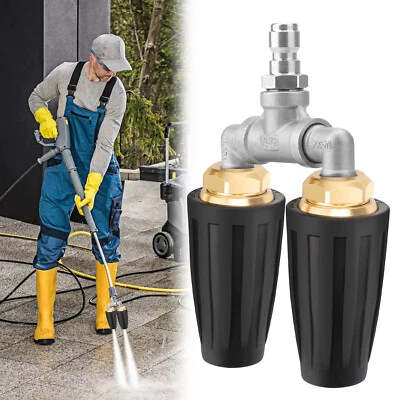
1/4-inch quick-connect fittings are among the most common nozzle connections. You often see them on spray tips, soap nozzles, and some accessory ends. They are easy to swap and very convenient for changing spray patterns.
These are not the same as hose fittings. A 1/4-inch quick-connect nozzle usually connects to a matching female socket on the wand or gun. It is a fast, practical system for everyday cleaning jobs.
Because they are so common, many people assume every 1/4-inch part is identical. The locking action is similar, but the pressure rating, seal quality, and material can still differ.
3/8-inch quick-connect fittings
3/8-inch quick-connect fittings are often used for hoses and higher-flow connections. They are larger than 1/4-inch fittings and are common where water volume matters more.
If you are connecting a hose to a machine or gun, 3/8-inch quick-connect parts may be the right choice. They can handle more flow and are often more stable for long hose runs.
Again, size matters. A 3/8-inch quick-connect is not interchangeable with a 1/4-inch version, even if they look similar from a distance.
Garden hose thread fittings
Some pressure washers use garden hose style threads at the water inlet. This is often where the machine connects to the household water supply. These fittings are not for the high-pressure side of the machine. They are usually on the low-pressure inlet side.
Garden hose threads are a common source of confusion because they seem familiar. But a garden hose thread does not mean it will fit on the pump outlet or the gun end. Always check where the fitting is used.
How threads work in pressure washer fittings
Thread compatibility is one of the most important parts of connector matching. A fitting can be the correct size on paper, but if the thread type is wrong, it will not seal.
Here are the ideas that matter most:
- Thread diameter is the size across the threaded part.
- Thread pitch is the distance between thread lines.
- Thread direction may be right-hand or left-hand, though most are standard right-hand threads.
- Thread standard tells you the system being used, such as metric or NPT.
Many people focus only on diameter and ignore pitch. That is a mistake. Two fittings can have a similar width and still fail to mate because the thread spacing is different.
If you are not sure about the thread, compare the old part with the new one side by side. Look at the shape, measure carefully, and check the product manual when possible. A digital caliper helps a lot.
Credit: ebay.com
NPT threads
NPT stands for National Pipe Thread. It is common in North American equipment. NPT threads are tapered, which means they get tighter as they screw in. That taper helps create a seal.
One common mistake is trying to mix NPT with non-tapered threads. They may start to thread, but they will not seal correctly.
BSP threads
BSP stands for British Standard Pipe. It is common in many regions outside North America. BSP threads may look similar to NPT, but they are not the same. This is a very important detail.
People often assume that if the size looks close, it will work. It usually does not. If you are buying international parts, always confirm whether the thread is BSP or NPT.
Metric threads
Metric threads are often seen on M22 fittings and some brand-specific equipment. They use millimeter-based sizing and a defined pitch. Metric threads are common in pressure washer connector types because many manufacturers use them for hoses and guns.
Metric fittings can be strong and reliable, but they are not forgiving if you guess. Always confirm the exact size before ordering.
Common connection points on a pressure washer
A pressure washer has several places where connectors matter. Each one may use a different type.
Water inlet
This is where the hose from your water source enters the machine. It is usually a low-pressure connection and often uses garden hose style threading.
Do not confuse the inlet with the high-pressure outlet. They are different and cannot be used interchangeably.
Pump outlet
The pump outlet is where pressurized water leaves the machine. This connection often uses M22, threaded fittings, or quick-connect hardware depending on the machine design.
This is one of the most important points to match correctly. If the outlet connection is wrong, the whole system fails.
Hose ends
The hose may connect to the machine on one end and to the trigger gun on the other. Some hoses use threaded ends. Others use quick-connect ends. Some have one of each.
Do not assume both ends of the hose use the same connector type. Many hoses are designed with different fittings on each side.
Trigger gun and wand
The trigger gun often connects to the hose through M22 or quick-connect. The wand or lance may then connect to the gun with another fitting style.
This is where accessories can become confusing. You may have a hose that fits the machine, but the gun does not accept the same end. Check each connection point separately.
Nozzle tips and accessories
Nozzle tips often use 1/4-inch quick-connect fittings. Foam cannons, surface cleaners, and specialty tools may use the same system or a different one based on brand and pressure level.
If you add accessories later, always check the connection style first. The attachment method matters more than the cleaning feature when you are trying to make a purchase.
What the most common sizes mean in real use
Size labels can be confusing. The number often does not mean the outside width of the whole fitting. It may describe thread size, internal passage, or nominal size. That is why many buyers make the wrong assumption.
The best way to think about it is this: the number is a code, not always a direct measurement. A 22 mm thread does not always mean you should measure 22 mm on the visible outer edge. Product families use naming rules that are sometimes technical and sometimes historical.
Here is a simple view of common uses:
| Connector type | Common use | What to watch for |
|---|---|---|
| 1/4-inch quick-connect | Nozzles, spray tips, foam accessories | Socket and plug shape must match |
| 3/8-inch quick-connect | Hoses, higher-flow accessories | Do not mix with 1/4-inch fittings |
| M22 | Hose and gun connections | Inner diameter may differ |
| Garden hose thread | Water inlet | Usually low-pressure only |
| NPT / BSP | Pumps, fittings, adapters | Thread standard must match exactly |
How to identify your connector type step by step
If you already own the pressure washer, you can identify the connector without guessing. Use a careful process and write down each measurement before ordering.
- Check the manual first. Many brands list the exact fitting type, accessory family, and size.
- Identify the connection point. Mark whether the part is for the water inlet, pump outlet, hose end, trigger gun, wand, nozzle, foam cannon, or surface cleaner.
- Look for markings. Search the part for stamped numbers, arrows, model codes, or pressure ratings.
- Measure the outside thread. Use a digital caliper across the widest outside thread diameter on a male fitting.
- Measure the inside insert or bore. On M22 fittings, check the inner insert carefully because 14 mm and 15 mm versions can look almost identical.
- Check thread pitch and shape. Compare tapered and straight threads, and use a thread pitch gauge when the manual does not give the size.
- Match the seal style. Confirm whether the seal depends on an O-ring, washer, conical seat, or tapered thread sealant.
- Verify pressure and flow rating. The accessory, hose, gun, wand, nozzle, and adapter should be rated equal to or higher than the pressure washer output.
For a simple caliper check, measure three places: the outside thread diameter, the inner insert or bore, and the O-ring seat area. Do not round a 14 mm insert up to 15 mm or assume a close photo match is enough.
A small detail many beginners miss is that some parts use adapters built into the accessory. That means the visible outer fitting may not show the true connector hidden inside. If a part seems strange, inspect both ends carefully.
Credit: ebay.com
Adapter use: when it helps and when it causes trouble
Adapters are useful, but they should not be the first solution for every problem. A good adapter can bridge two different thread styles or sizes. A poor adapter can add weak points, create leaks, and make the setup longer and heavier.
Use adapters when the parts are otherwise correct and the adapter is rated for pressure washer use. Avoid using random plumbing fittings that were not made for high pressure. They may fit in a loose physical sense but fail in real use.
One non-obvious issue is seal quality. Even if an adapter fits, the seal may depend on an O-ring, washer, or conical seat. If that seal is missing or damaged, the connection will leak no matter how tightly you turn it.
Also check whether the brand uses a proprietary connection system. Karcher, for example, publishes adapter and hose compatibility charts for matching older and newer connections. That is a useful reminder that model-specific compatibility can matter even when the thread name looks familiar.
Signs an adapter is the wrong choice
- You must force the threads to start.
- The connection leaks even after tightening.
- The hose feels twisted or stressed.
- The adapter adds too much length and makes the gun awkward.
- The parts look stable, but the seal depends on tape only.
How to avoid common buying mistakes
Most connector problems happen before the washer is even turned on. People buy based on shape, not on exact fitting details.
Here are the mistakes that happen most often:
- Assuming all M22 fittings are the same. The inner size can differ.
- Mixing NPT and BSP threads. They are not interchangeable.
- Buying by color or brand name only. Appearance does not guarantee fit.
- Using a garden hose fitting on a pressure outlet. That is the wrong side of the system.
- Forcing almost-right threads. This can damage both parts.
Another mistake is forgetting about pressure rating. Even if the connector fits, it still has to handle the machine’s working pressure. A weak connector may hold for a short time and fail later under load.
What to check before ordering a replacement part
Before you click buy, confirm these points:
- Is the part for the low-pressure water inlet or the high-pressure outlet side?
- Is the connection quick-connect or threaded?
- What is the exact thread standard?
- What is the exact size, including inner size if relevant?
- What PSI and GPM rating does the pressure washer have?
- Is the hose, gun, wand, nozzle, or adapter rated equal to or higher than the pressure washer?
- Does it include the correct O-ring, washer, or sealing seat?
- Does your brand require a model-specific adapter or hose kit?
Rated pressure matters because a connector can physically fit and still be unsafe or leak under load. Simpson’s pressure washer manual warns users to use accessories rated equal to or greater than the pressure washer rating. Karcher’s adapter and hose charts also show why model-specific compatibility matters for some systems.
If you still feel unsure, compare your part with the replacement photo from the seller. Good sellers often show the end shape clearly. If not, look for customer images or technical drawings. Reliable product details are worth more than a vague title.
For manufacturer-backed checks, review the Simpson pressure washer manual, the Karcher adapter finder, and the Karcher hose compatibility chart when those brands or adapter systems apply.
Practical pairing examples
Here are a few simple examples to make the idea easier to remember.
| Pairing | Match first | Then confirm |
|---|---|---|
| Machine outlet to hose | M22, quick-connect, or brand outlet type | Inner insert, O-ring, PSI rating, and hose GPM fit |
| Hose to gun | Gun inlet thread or quick-connect socket | Whether the hose end is male/female and 14 mm or 15 mm if M22 |
| Gun to wand | Brand interface or threaded collar style | Whether a proprietary adapter is required |
| Wand to nozzle | 1/4-inch quick-connect plug/socket style | Nozzle or accessory pressure rating |
Credit: ebay.com
Example 1: hose to gun
Your hose may use an M22 connector on the gun side. If your new gun also uses M22, it still may not fit if the inner diameter is different. You must check the exact version, not just the name.
Example 2: nozzle to wand
A spray nozzle often uses 1/4-inch quick-connect. If your wand has a matching female socket, the nozzle should lock in quickly. This is one of the easiest and most common connections on a pressure washer.
Example 3: machine inlet
The water supply inlet may use a garden hose thread. This lets you connect a standard garden hose. But remember, this is only for water supply, not high-pressure output.
Example 4: international replacement parts
If you buy a replacement part from another country, check the thread standard carefully. A fitting may look identical in photos, yet use BSP instead of NPT. That small difference is enough to stop proper sealing.
Quick way to think about connector compatibility
If you want a simple rule, remember this:
Match the connection style, match the thread standard, and match the size exactly.
If even one of those three is wrong, the part may not fit or may leak. That is why the best approach is careful checking, not guesswork.
Also, do not rely on “universal” product claims without reading the details. In pressure washer connector types, universal usually means “works with several common fittings,” not “fits everything.”
Final buying advice for better fit and fewer leaks
If you are replacing a connector, start with the old part. Clean it. Read any markings. Measure it. Compare it with the new item before installing. If possible, buy from a seller that lists the exact fitting type and pressure rating.
For regular homeowners, the best choice is usually the simplest one: keep the same fitting style as the original unless you have a clear reason to change it. That reduces the chance of mismatch and makes future replacement easier.
Once you know how pressure washer connector types work, the whole system becomes easier to manage. You will spend less time guessing and more time cleaning.
Frequently asked questions
1. Are all pressure washer connectors universal?
No. Many parts look similar, but they are not universal. Size, thread standard, and connection style must all match for a proper fit.
2. What is the most common connector type on pressure washers?
M22 and quick-connect fittings are very common. M22 is often used on hoses and guns, while 1/4-inch quick-connect is common for nozzles and spray tips.
3. How do I know if I need NPT or BSP threads?
Check the manual, product listing, or original part markings. If you are replacing a part from an imported machine, BSP is often more likely. Do not guess, because NPT and BSP are not the same.
4. Why does my fitting leak even though it screws on?
The thread may be the wrong type, the size may be slightly off, or the seal may be damaged. A missing O-ring or washer can also cause leaks.
5. Can I use an adapter for every connector problem?
Not always. Adapters help when two compatible systems need a bridge, but they should be pressure-rated and correctly sealed. If the fit is far off, the better solution is the correct matching part.
