
A weak battery can cause many small problems before it fully dies. The engine may crank slowly. The lights may look dim. The car may start one day and fail the next. These signs are easy to ignore, but they often point to a battery that is losing power.
The good news is that you do not need special garage tools to check it. A basic multimeter can tell you a lot in just a few minutes. If you learn how to test car battery with multimeter, you can find out whether the battery is healthy, low, or close to failure.
This guide will show you the full process in simple steps. You will learn how to test the battery at rest, while starting the car, and while the engine is running. You will also learn what the numbers mean, common mistakes to avoid, and when it is time to replace the battery instead of trying to charge it again.
For related checks, compare this process with how to test a regular battery with a multimeter and how to test ground with a multimeter when tracking electrical faults.
What you need before you begin
You do not need many tools for this job. A digital multimeter is enough for most drivers. If your multimeter has a DC voltage setting, you are ready to go.
Before testing, make sure the car is parked safely. Turn off the engine, lights, radio, and air conditioning. Keep the car in park or neutral, and set the parking brake. If the battery looks swollen, cracked, or leaking, do not test it aggressively. In that case, it is safer to have it checked by a professional.
Here is a simple set of things to have ready:
- Digital multimeter
- Gloves, if available
- Safety glasses, if available
- Clean cloth for wiping dirt from battery terminals
A clean connection matters more than many beginners think. Dirt, white powder, or rust on the terminals can affect the reading and make a good battery look weak. That is one of the most common mistakes people miss.
For related checks, compare this process with how to test a regular battery with a multimeter and how to test ground with a multimeter when tracking electrical faults.
How to test car battery with multimeter step by step
The main test is simple. You measure the battery voltage when the car is off. This tells you how much charge the battery holds at rest.
1. Set the multimeter correctly
Turn the multimeter dial to DC voltage. If your meter has range settings, choose a range above 12 volts. Many meters have a 20V DC setting, which works well for car batteries.
Plug the black probe into the COM port. Plug the red probe into the port marked for voltage, often written as V or VΩ.
2. Touch the probes to the battery terminals
Open the hood and find the battery. The positive terminal usually has a plus sign and may be covered in red. The negative terminal has a minus sign and is often black.
Place the red probe on the positive terminal. Place the black probe on the negative terminal. Hold them steady for a few seconds until the reading on the screen becomes stable.
If the screen shows a negative number, the probes are reversed. That is not a problem. Just swap them.
3. Read the voltage
A healthy, fully charged 12-volt car battery usually reads around 12.6 volts or a little more when the engine is off. A reading near 12.4 volts means the battery is partly charged. A reading around 12.2 volts or lower often means the battery is weak or low.
Use this simple guide:
| Battery voltage | What it usually means |
|---|---|
| 12.6V to 12.8V | Battery is fully charged and likely healthy |
| 12.4V to 12.5V | Battery is partly charged |
| 12.2V to 12.3V | Battery is getting weak or undercharged |
| Below 12.0V | Battery is very low and may need charging or replacement |
One important detail: a good voltage reading does not always mean the battery is truly strong. A battery can show decent voltage but still fail under load. That is why the next tests matter too.
For related checks, compare this process with how to test a regular battery with a multimeter and how to test ground with a multimeter when tracking electrical faults.
Test the battery while starting the car
This is where many battery problems show up. A battery may look fine at rest but collapse when the starter asks for power. Testing during startup helps reveal that weakness.
Keep the probes on the battery terminals. Ask someone to start the car while you watch the multimeter. If you are alone, place the meter where you can see it from the driver’s seat, but make sure it is safe and the leads are secure.
When the engine starts, the voltage will drop for a moment. That is normal. What matters is how low it drops.
A strong battery usually should not fall much below 9.6 volts during starting in normal conditions. If the voltage drops below that level, the battery may be weak, especially if the weather is warm and the battery is not old.
Here is the key idea beginners often miss: the starting test is often more useful than the resting test. A battery can look “okay” at 12.4 volts and still fail to start the car because its internal resistance is too high. That means it cannot deliver enough current when needed.
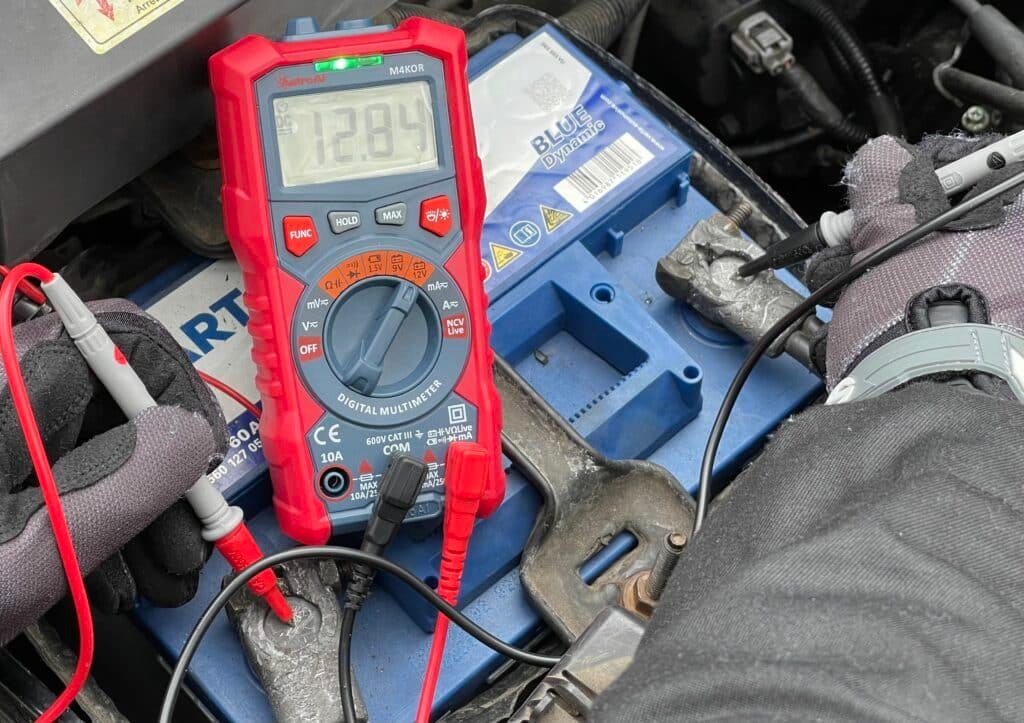
Credit: classiccarmaintenance.com
For related checks, compare this process with how to test a regular battery with a multimeter and how to test ground with a multimeter when tracking electrical faults.
Check the charging system after the engine starts
After the car starts, keep the probes connected and look at the voltage again. This tells you if the alternator is charging the battery properly.
With the engine running, a healthy charging system usually shows about 13.7 to 14.7 volts. The exact number can vary by vehicle, weather, and battery type.
If the reading stays near the resting voltage, such as 12.2 or 12.5 volts, the alternator may not be charging. If the voltage is too high, such as above 15 volts, the charging system may be overcharging the battery. Both problems can damage the battery.
If you want a trusted explanation of vehicle battery basics, the U.S. Department of Energy offers helpful information about how temperature affects batteries and vehicle performance. While it focuses on EVs in part, the battery principles are still useful.
For related checks, compare this process with how to test a regular battery with a multimeter and how to test ground with a multimeter when tracking electrical faults.
Understand what your reading means
Many people stop after seeing one number. That is a mistake. Battery voltage should be read with context. You need to know when the test was done, how the car behaved, and whether the charging system is working.
Here is a simple way to think about it:
- Good at rest, poor during start: The battery may be weak even if it is charged.
- Low at rest, good after charging: The battery may just be discharged, not dead.
- Good at rest, low while engine runs: The alternator or charging system may be the problem.
- Low at rest and low during start: The battery may be near the end of its life.
This is the second insight many beginners miss: a battery problem is not always a battery problem. Sometimes the real issue is poor charging, loose terminals, or corrosion at the connection points. Replacing the battery without checking these things can waste money.
Common voltage results and their meaning
| Test situation | Normal result | Possible problem |
|---|---|---|
| Engine off | 12.6V to 12.8V | Below 12.2V may mean low charge or weak battery |
| Starting the engine | Should stay near or above 9.6V | Lower than this may show battery weakness |
| Engine running | 13.7V to 14.7V | Lower may mean charging failure, higher may mean overcharging |
For related checks, compare this process with how to test a regular battery with a multimeter and how to test ground with a multimeter when tracking electrical faults.
Clean and retest if the numbers look strange
If your reading seems too low or jumps around, do not rush to buy a new battery. First, inspect the terminals. A thin layer of corrosion can block current and distort the test.
Turn the car off again and look closely at the battery posts and cable clamps. If you see white, blue, or green buildup, clean it carefully. Use a proper battery terminal cleaning tool if you have one, or have the battery serviced by a mechanic if you are not comfortable doing it yourself.
After cleaning, test again. A better connection often gives a more accurate reading right away.
Also check these simple things:
- The probes are touching metal, not plastic or dirt
- The multimeter is set to DC voltage, not AC
- The battery has been off for a few minutes before the resting test
- The meter leads are plugged into the correct ports
Small setup errors can create confusing results. This is one reason people sometimes think a battery is dead when it is not.
For related checks, compare this process with how to test a regular battery with a multimeter and how to test ground with a multimeter when tracking electrical faults.
When to charge the battery and when to replace it
If the battery shows a low resting voltage but still seems physically fine, charging it may help. After charging, let it rest for a while and test again. If the voltage returns to a healthy range and the car starts normally, the battery may still have useful life left.
But if the battery repeatedly drops low after charging, or if it fails the starting test again and again, replacement is usually the better choice.
Watch for these warning signs:
- The battery is more than 3 to 5 years old
- The car cranks slowly even after a full charge
- The battery voltage falls too fast after charging
- The battery case is swollen or leaking
- The battery has needed jump-starts several times recently
Age matters more than many drivers realize. Batteries do not fail all at once. They weaken slowly, and weather, driving habits, and short trips can shorten their life.

Credit: blog.caask.ca
For related checks, compare this process with how to test a regular battery with a multimeter and how to test ground with a multimeter when tracking electrical faults.
How temperature affects the test
Cold weather can make a battery seem weaker than it is. In low temperatures, chemical activity slows down, and the battery cannot deliver power as easily. This is why a battery that works in summer may fail in winter.
Hot weather is also harmful. Heat can damage battery parts over time and cause faster wear inside the case. In some climates, batteries fail sooner because of heat, not cold.
When testing in very cold weather, keep in mind that a slightly lower reading may not tell the full story. Still, if the voltage is very low, the battery is likely weak no matter the season.
For related checks, compare this process with how to test a regular battery with a multimeter and how to test ground with a multimeter when tracking electrical faults.
Common mistakes to avoid
If you want reliable results, avoid these errors:
- Testing too soon after charging — A freshly charged battery can show a false high reading. Let it rest first.
- Ignoring corrosion — Dirty terminals can spoil the test and cause starting problems.
- Using the wrong meter setting — AC voltage will not help here. Use DC voltage.
- Testing only once — Repeat the test if the result seems unstable or unexpected.
- Judging the battery by voltage alone — A battery also needs to perform under load.
Another useful habit is to test the battery more than one time over several days. If the reading keeps dropping after the car sits, the battery may be self-discharging or the car may have a drain problem.
For related checks, compare this process with how to test a regular battery with a multimeter and how to test ground with a multimeter when tracking electrical faults.
Simple example of a real-world test
Imagine your car has trouble starting on Monday morning. You use the multimeter and get 12.3 volts with the engine off. That number shows the battery is not fully charged.
Then you start the car. The voltage drops to 8.9 volts before the engine catches. That is too low. After the engine starts, the reading rises to 14.2 volts, which means the alternator is probably working.
In this case, the battery itself is likely weak. The charging system looks fine, but the battery cannot supply enough power during startup.
Now imagine a different case. The battery reads 12.6 volts at rest, but only 12.4 volts while the engine runs. That points away from the battery and toward the alternator or wiring.
These small details help you avoid the wrong repair.
For related checks, compare this process with how to test a regular battery with a multimeter and how to test ground with a multimeter when tracking electrical faults.
Final thoughts on getting a reliable result
Learning how to test car battery with multimeter is one of the easiest ways to understand your car’s condition. It saves time, reduces guesswork, and helps you catch problems early.
Start with the resting voltage. Then test during startup. Then check the charging voltage with the engine running. When you combine these three checks, you get a much clearer picture than any single reading can give.
Remember the two most important lessons. First, a battery can look fine but still fail under load. Second, not every starting problem comes from the battery itself. Sometimes the real issue is corrosion, a bad alternator, or a loose connection.
If you use the multimeter the right way, you can make a smart decision about charging, cleaning, repairing, or replacing the battery. That is better for your car and better for your budget.
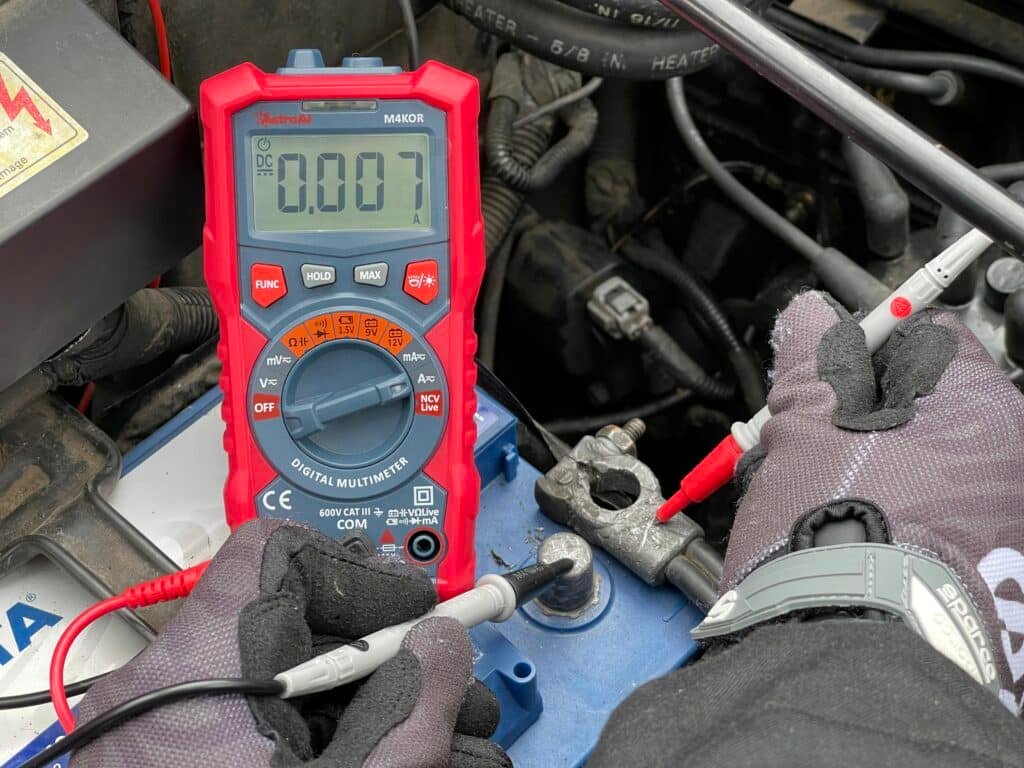
Credit: classiccarmaintenance.com
For related checks, compare this process with how to test a regular battery with a multimeter and how to test ground with a multimeter when tracking electrical faults.
FAQs
1. What is the best multimeter setting for testing a car battery?
Use DC voltage. For most digital multimeters, the 20V DC range works well for a 12-volt car battery. Make sure the red probe is in the voltage port and the black probe is in the COM port.
2. What voltage means a car battery is bad?
A resting voltage below 12.0 volts is usually a bad sign. If the battery also drops below about 9.6 volts while starting the car, it may be weak or near failure. Final judgment should also include starting performance and charging test results.
3. Can a car battery be bad even if it shows 12.6 volts?
Yes. A battery can show good resting voltage and still fail under load. That is why the startup test matters. A weak battery may look fine when idle but collapse when the engine needs high current.
4. How long should I leave the car off before testing the battery?
For the most accurate resting reading, let the car sit for at least 15 to 30 minutes after driving or charging. This helps remove surface charge and gives a more honest voltage result.
5. Do I need to disconnect the battery to test it with a multimeter?
No. You can test the battery while it is still connected in the car. In fact, that is the normal and easiest way to do it. Just make sure the car is off before the resting test and keep the probes steady on the terminals.
