
If you have ever looked at a small fastener and wondered why one person calls it a grub screw while another says set screw, you are not alone. These two names are often used for the same part, but the details can still matter a lot in real use.
Choosing the wrong fastener can lead to loose parts, damaged shafts, weak hold, or problems during maintenance. That is why understanding grub screw vs set screw is useful, especially if you work with machinery, furniture, tools, or mechanical assemblies.
In simple terms, both are headless screws used to fix one part against another. But the way people use the names, the design details, and the best use cases can differ by region, industry, and application. Let’s make that clear in a practical way.
What these fasteners actually do
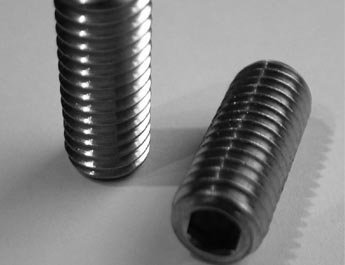
A grub screw or set screw is a headless threaded fastener. It is usually driven with an internal hex, slot, or other recess. Instead of holding two parts together from the outside, it is tightened so the tip presses directly against another object, often a shaft.
This makes them useful when you want a part to stay in one place without adding a nut or a visible head. Common examples include pulleys, knobs, gears, collars, machine parts, and some furniture fittings.
The main job is simple: prevent movement. But the way that grip is created depends on the tip shape, thread size, material, and how hard the screw is tightened.
The real difference between grub screw and set screw
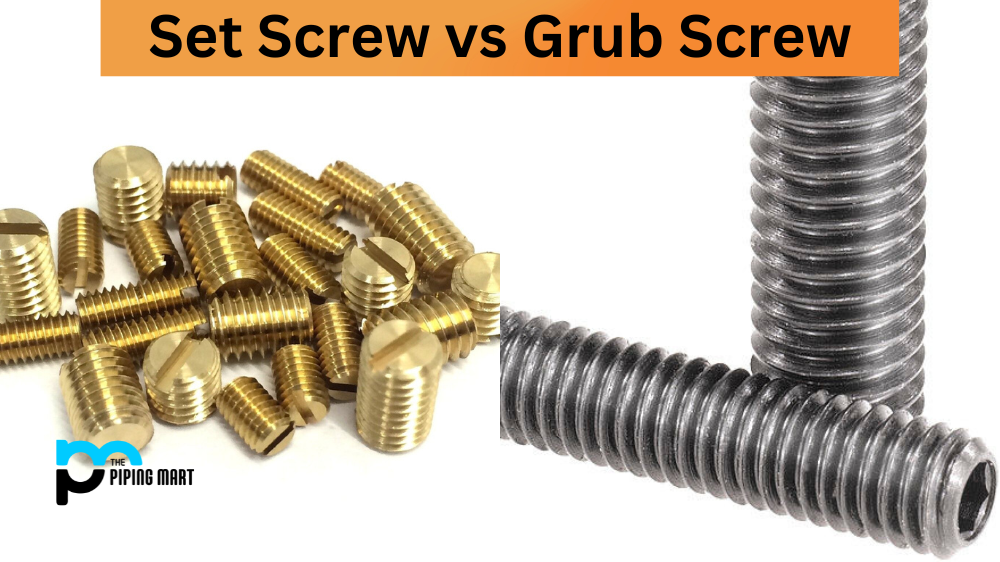
The biggest point to understand is this: in many countries and industries, grub screw and set screw mean the same thing. The words are often used interchangeably.
Still, in practice, people sometimes use them differently:
- Set screw is a broader term for a headless screw that secures one part to another.
- Grub screw is often used more commonly in British English and may refer to a fully headless screw used to lock parts in place.
In some settings, “set screw” may also describe a screw with a specific purpose, such as holding a handle, gear, or collar in position. In other settings, “grub screw” may simply be the local name for the same thing.
So if you are comparing grub screw vs set screw, the most useful approach is not to focus only on the name. Focus on the dimensions, tip style, material, and thread standard.
Why the naming can be confusing
Fastener names are not always consistent across countries. A supplier catalog in one region may say “grub screw,” while another says “set screw” for the same item. Even mechanics and engineers sometimes use both words casually.
This can create mistakes when ordering replacements. For example, a customer may ask for a set screw, but the supplier needs to know:
- the thread size
- the length
- the tip type
- the material
- the drive type
Without these details, the name alone is not enough.
How they are designed
Most grub screws and set screws share a similar basic shape: a cylindrical body, external threads, and no protruding head. What changes is the drive and the tip.
The drive is the part you turn with a tool. Common drives include hex socket, slot, Torx, and square socket. The tip is the end that touches the surface or shaft.
Tip shape matters more than many beginners realize. It changes how much pressure is applied, how much grip you get, and how likely the screw is to damage the contact surface.
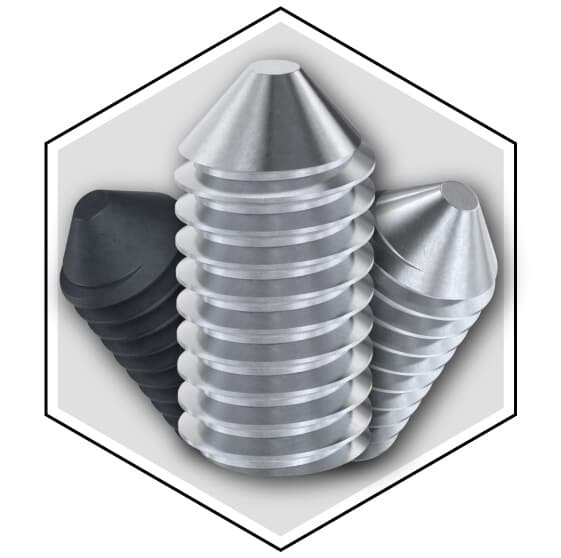
Common tip types
- Flat point — spreads force over a wider area and is often used for general locking.
- Cup point — has a small concave tip that bites into the shaft for stronger hold.
- Cone point — sharp and precise, useful where accurate positioning matters.
- Dog point — has a reduced tip for locating parts without deep surface damage.
- Knurled cup point — designed for extra grip in softer materials.
This is one of the most important non-obvious points: the tip style often matters more than the name. A poorly chosen tip can fail even if the screw size looks correct.
Key differences that matter in real use
Although the naming overlap is large, there are still practical differences to think about. These differences are not always about the screw itself. They are often about how the screw is described, sold, and used.
| Feature | Grub screw | Set screw |
|---|---|---|
| Name usage | Common in British English and some technical catalogs | Common in American English and general hardware use |
| Basic shape | Usually headless | Usually headless |
| Main purpose | Locking or positioning a part | Locking or positioning a part |
| Tip styles | Flat, cup, cone, dog point, and more | Flat, cup, cone, dog point, and more |
| Practical difference | Often a naming preference | Often a naming preference |
The table shows the important truth: in many cases, the difference is terminology, not function. That is why a smart buyer checks the specification sheet instead of relying on the name alone.
Credit: surajmetal.com
What beginners often miss
First, the material of the screw can be just as important as the thread size. Stainless steel resists rust, but alloy steel may offer more strength. In a wet or outdoor area, the wrong material can fail early.
Second, the surface being contacted matters. A hard cup point on a soft aluminum shaft can leave marks or create burrs. That may be fine in some machines, but not in others.
Where grub screws and set screws are used
These fasteners are common in many mechanical systems because they are small, low-cost, and effective. They are used where a part must stay fixed on a shaft or inside a component.
Typical applications
- Holding gears on shafts
- Fixing collars in place
- Securing pulleys
- Locking knobs and handles
- Adjusting small machine parts
- Positioning tool components
- Furniture fittings and hidden joins
In many assemblies, the screw does not carry the main load by itself. Instead, it stops slippage or rotation. That is why proper tightening and correct tip selection are so important.
When they work best
They work best when the joint does not need repeated disassembly and when the mating parts are made for this type of fastening. A shaft with a flat or dimpled contact point usually performs better than a smooth round shaft in high-load use.
If the assembly is exposed to vibration, heat, or frequent movement, a plain screw alone may not be enough. In those cases, thread-locking methods, better torque control, or a more suitable fastening design may be needed.
How to choose the right one
The best choice is not “grub screw” or “set screw” as a name. The best choice is the screw that matches your application. Here is what you should check.
1. Match the thread size exactly
This sounds obvious, but it is the most common mistake. A screw can look close in size and still be wrong. Metric and imperial threads are not interchangeable.
Check the major diameter, thread pitch, and length. If possible, measure the old screw or the tapped hole with the right tools.
2. Choose the right tip type
The tip type changes how the force is applied. A cup point is good for strong holding. A flat point is better when you want less surface damage. A cone point is more precise but can leave deeper marks.
If you are locking a part that should not be scarred, this choice matters a lot. This is another detail beginners often overlook.
3. Think about the material
Common materials include carbon steel, alloy steel, and stainless steel. Some are black oxide coated, zinc plated, or left plain.
Use stainless steel if corrosion resistance matters. Use stronger alloy steel when mechanical strength is more important. In dry indoor use, a coated carbon steel screw may be enough.
4. Check the drive type
Hex socket screws are common because they are compact and easy to tighten with an Allen key. Slot drives are simple but less convenient. Torx drives can offer better torque transfer and less tool slip.
For small screws, a good drive type can make installation much easier and reduce stripping.
5. Look at the working environment
Heat, vibration, moisture, and chemicals all affect performance. A screw that works fine in a dry workshop may not last in a marine or outdoor setting.
If the screw will be exposed to vibration, check whether the design needs added locking methods. A set screw can loosen over time if the contact point and torque are not suitable.
Grub screw vs set screw in different industries
The language changes by country and sector, but the function stays similar. In manufacturing, engineers often care more about the exact standard than the casual name. In retail hardware, the label can be more general.
In British usage, “grub screw” is a very common term. In American usage, “set screw” is more common. In technical drawings, the dimensions and specifications should remove confusion.
That is why professionals usually rely on standards, part numbers, and drawings. If you want to be precise, use the full specification instead of only the word.
For general reference on naming and technical language, a good starting point is the Encyclopaedia Britannica overview of fasteners.
Credit: accu-components.com
Common mistakes when buying or using them
Many problems with grub screws and set screws are not caused by poor quality. They are caused by bad selection or bad installation.
Using the wrong length
If the screw is too short, it may not grip enough thread. If it is too long, it may bottom out before it tightens properly. That can make the joint feel tight when it is not actually secure.
Over-tightening
More torque is not always better. Over-tightening can strip the threads, crack soft materials, or deform the shaft. A small screw can fail much sooner than people expect.
Ignoring the contact surface
A hard tip against a soft part can create a groove. That groove may make future removal harder and can weaken the part. If the contact point will be adjusted many times, use a design that protects the surface better.
Mixing thread standards
This is a classic mistake. A metric screw may almost fit an imperial hole, but “almost” is not enough in fastening. It can cause thread damage that becomes hard to fix.
How to install them properly
Good installation improves grip and reduces damage. The process is simple, but the details matter.
- Clean the threaded hole and the screw.
- Check that the screw matches the thread and length.
- Align the part correctly before tightening.
- Use the correct driver size to avoid stripping the recess.
- Tighten gradually, not with sudden force.
- Test the part for movement after installation.
If you are working with a shaft, it helps to make sure the screw contacts the right spot. Some assemblies use a dimple or flat area so the screw can seat better. That small detail can greatly improve holding power.
A useful rule of thumb
If the screw keeps loosening, do not instantly blame the screw itself. Check the shaft surface, thread condition, material choice, and vibration level first. In many cases, the real problem is one of these details.
Which one should you choose?
If your only question is the name, the answer is simple: in most cases, grub screw vs set screw is a naming difference, not a product difference. But if you want the right part, the useful question is this: what exactly does the application need?
Choose based on the following:
- Use grub screw if that is the term your supplier or region uses.
- Use set screw if that is the standard term in your market or drawing.
- Choose the tip type based on grip and surface protection.
- Choose the material based on strength and corrosion resistance.
- Choose the size based on thread standard, length, and available space.
In other words, the best choice is not about the label alone. It is about the full fit between the fastener and the job.
Practical examples
Imagine you are fixing a pulley on a motor shaft. A cup point set screw may be a good choice because it bites into the shaft and resists slip. If the shaft must stay smooth, a different tip or a shaft dimple may be better.
Now imagine a small control knob on a piece of equipment. A flat or cone point grub screw may be used to hold the knob in place without large visible hardware. Here, appearance and easy access may matter more than maximum bite.
For stainless outdoor hardware, the material may matter more than the naming. A stainless version can prevent corrosion and save maintenance time later.
Credit: blog.thepipingmart.com
Final thoughts
The debate around grub screw vs set screw is often less about the fastener itself and more about language. In many cases, both words describe the same type of headless screw used to lock parts in place.
What truly matters is the specification: thread size, length, tip type, material, drive style, and working environment. If you pay attention to those details, you will avoid most buying mistakes and get a much better result in real use.
So next time you see one of these fasteners, do not stop at the name. Look at the function, the fit, and the surface it will contact. That is the real way to choose well.
FAQs
1. Are grub screws and set screws the same thing?
In many cases, yes. The two names are often used for the same headless fastener. The exact term depends on the country, industry, or supplier.
2. Why do some catalogs use grub screw and others use set screw?
It is mostly a language difference. British English often uses “grub screw,” while American English more often uses “set screw.” The product may be identical.
3. Which tip type is strongest?
A cup point often gives strong holding power because it bites into the surface. But the strongest choice depends on the material being fastened and whether surface damage is acceptable.
4. Can I replace one with the other?
Usually yes, if the thread size, length, drive, and tip type match the application. Always check the full specification before replacing.
5. What is the biggest mistake people make when buying these screws?
The biggest mistake is buying by name only. Thread size, length, material, and tip style matter much more than whether the part is called a grub screw or a set screw.
