
If you work on home projects, you will likely need to trim PVC at some point. The good news is that can you cut pvc with miter saw is a common question with a simple answer: yes, you usually can. A miter saw is one of the fastest ways to get clean, square cuts on PVC pipe and PVC trim.
But there is an important detail many people miss. Cutting PVC is not the same as cutting wood. Plastic can move, melt, chip, or throw off small bits if you use the wrong blade, speed, or pressure. That means the tool is useful, but only if you use it the right way.
In this guide, you will learn when a miter saw works well for PVC, how to cut safely, which mistakes to avoid, and how to get better results with less mess. Whether you are cutting pipe for plumbing or trim for a renovation, the steps below will help you work faster and with more confidence.
For more cutting-tool guidance, compare whether you can cut metal with a miter saw, browse practical miter saw DIY projects, and review the best way to cut styrofoam for other lightweight materials.
Yes, a miter saw can cut PVC very well
A miter saw is often a great choice for PVC because it gives you control, speed, and repeatable cuts. It is especially useful when you need several pieces the same length, or when you want clean angled cuts for framing, trim, or pipe fittings.
PVC is softer than wood and much softer than metal, so the saw does not need a lot of force. In fact, using too much pressure can make the cut worse. The blade may grab the material, leave rough edges, or create heat that melts the plastic slightly.
For most home users, a standard compound miter saw works well for:
- PVC pipe
- PVC trim boards
- Vinyl molding
- Thin plastic profiles
The best results usually come from a sharp blade, a steady hold, and a slow, smooth cut. If you already own a miter saw, you likely do not need a special plastic-cutting machine for common PVC work.
When a miter saw is the right tool for PVC
A miter saw is not the only way to cut PVC, but it is one of the easiest for many jobs. It shines when the cut must be accurate and repeated many times.
Good situations for using a miter saw
Use a miter saw when you need:
- Straight cuts across pipe or trim
- 45-degree corners for trim joints
- Multiple pieces cut to the same length
- Fast work on small to medium PVC pieces
It is especially helpful for trim work because the saw can make clean angles that fit tightly at corners. It also saves time when you are cutting several pieces for a fence, conduit cover, or base trim.
When another tool may be better
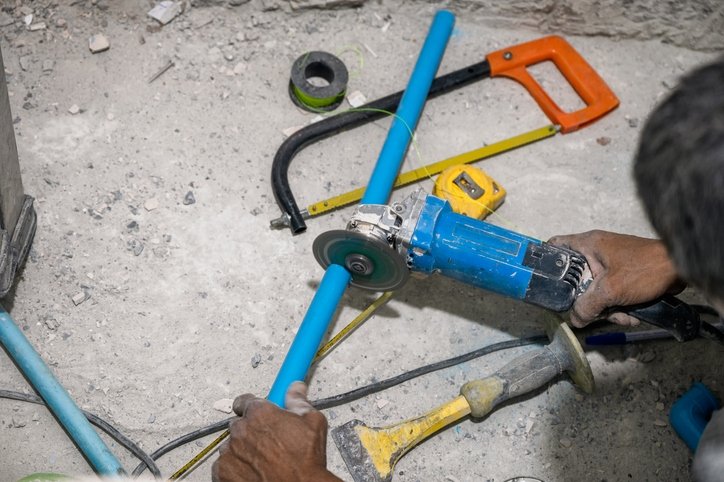
Sometimes a different tool is safer or easier. A miter saw is not ideal if the piece is very large, awkward, or already installed in a tight place. In those cases, you may prefer a PVC cutter, handsaw, or oscillating tool.
If the cut is close to a wall or inside a cabinet, a portable hand tool may be easier and safer than bringing the part to the saw.
What matters most before you start cutting
Many people focus only on the saw, but the blade and setup matter just as much. If you want a clean cut, the details below can make a big difference.
Use the right blade
A fine-tooth blade is usually the best choice for PVC. A blade made for finish work or trim often works better than a rough framing blade. More teeth usually mean a smoother cut and less chipping.
For most PVC work, a blade with a high tooth count helps reduce tearing. It also lowers the chance that the plastic will snag as the blade passes through.
Keep the blade sharp
A dull blade can heat the PVC more than necessary. That heat may leave a rough edge, slight melting, or a shiny line where the blade dragged. A sharp blade cuts cleaner and feels easier to control.
This is one of the most ignored points. Beginners often think the saw is the problem, when the real issue is simply a worn blade.
Support the material well
PVC should sit flat and steady on the saw bed. If the piece lifts, twists, or vibrates during the cut, the result will be messy. Long pieces may need extra support from both sides so the weight does not pull the material down.
For pipe, make sure it cannot roll. For trim boards, keep the piece tight against the fence and the table.
Check the cut line before you start
Mark the cut clearly with a pencil or fine marker. If the mark is hard to see, the chance of a bad cut goes up. Take a moment to double-check the angle before lowering the blade.
How to cut PVC with a miter saw safely
Safety matters more than speed. PVC cuts are usually easy, but the blade still moves fast and the material can shift. Use a calm, controlled process every time.
- Measure the PVC carefully and mark the cut line clearly.
- Set the miter saw to the angle you need.
- Choose a sharp, fine-tooth blade.
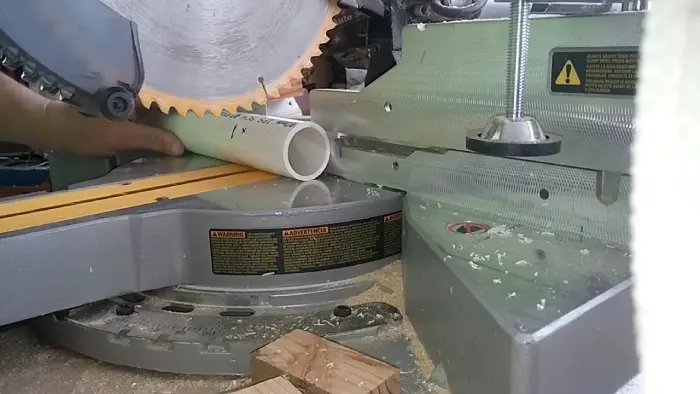
- Place the PVC firmly against the fence and table.
- Hold the piece with both hands, keeping fingers far from the blade path.
- Start the saw and let it reach full speed before lowering it.
- Lower the blade slowly through the PVC without forcing it.
- Keep the blade moving at a steady pace until the cut is complete.
- Wait for the blade to stop before lifting it back up.
- Remove the cut piece and smooth the edge if needed.
One small habit can improve both safety and cut quality: let the saw do the work. If you push too hard, you can make the blade bind, which creates heat and a rough finish.
Credit: woodhandy.com
Wear basic protection
Use eye protection every time. Small plastic chips can fly from the cut. Hearing protection is also smart if you are making many cuts or working in a closed space.
If the job creates dust, wear a mask or respirator that fits the task. PVC does not usually create the same dust level as wood, but the small particles are still not something you want to breathe in.
Keep your hands clear
This sounds obvious, but PVC pieces are often lightweight and easy to adjust with your fingers. That is risky near a spinning blade. Use clamps when possible, and always keep your grip outside the blade path.
Best practices for cleaner PVC cuts
A clean cut is not just about looks. It also helps the PVC fit better, seal better, and work as intended. Small improvements in setup can save time later.
Cut at a steady pace
Do not rush the cut. A steady pace helps the blade slice through the material without grabbing it. PVC is easiest to cut when you avoid sudden pressure.
If you see melting or rough edges, slow down and check the blade. The problem is often heat, not the material itself.
Use a backer board for trim work
When cutting PVC trim boards, a scrap board behind the piece can reduce chipping on the exit side. This is a simple trick that many beginners skip.
It is not always needed, but it can help when you want a cleaner finish on visible edges.
Trim only after measuring twice
PVC trim and pipe often need exact lengths. A mistake of even a small amount can cause poor fit. Measure twice, cut once, and check the angle before you begin.
This is especially important for corner joints. If one side is slightly off, the whole joint may look uneven.
Deburr the edge after cutting
After the cut, use a utility knife, sanding block, or deburring tool to smooth the edge. This helps pipes fit into fittings more easily and gives trim a cleaner finish.
For plumbing work, a burr can make assembly harder and can interfere with a proper connection. For trim, a smooth edge looks better and reduces visible flaws.
Work in a stable temperature
PVC behaves a little differently in very cold or very hot conditions. Cold PVC can feel more brittle, while warm PVC may be a bit softer. This does not stop you from cutting it, but it can affect how clean the cut looks.
If possible, keep the material at a normal room temperature before cutting.
Common mistakes people make when cutting PVC
Most bad cuts happen for a few simple reasons. If you know these mistakes early, you can avoid wasted material and frustration.
Credit: thesawblog.com
Using a blade that is too rough
A coarse blade may cut fast, but it can leave a jagged edge or chip the PVC. Many people use the same blade for wood and plastic without thinking about the result. For cleaner PVC cuts, a finer blade is usually better.
Pushing the blade too hard
Pressure is a common mistake. If you force the blade through the cut, the PVC may melt slightly or move out of position. A slower, lighter touch usually gives a cleaner result.
Not supporting long pieces
Long PVC pipe or trim can sag on one side. That sag changes the cut angle and can pinch the blade. Use extra support for long pieces so the cut stays straight.
Skipping the test cut
If you are cutting an expensive piece or working on a visible project, a quick test cut on scrap PVC is worth the time. It helps you confirm the blade, angle, and feed speed before you cut the real piece.
Ignoring small burrs
Some people think a tiny burr does not matter. But burrs can cause fit problems, especially with pipe. A few seconds of cleanup can prevent bigger problems during installation.
How to get better results on PVC trim versus PVC pipe
Not all PVC cuts are the same. Pipe and trim need different thinking, even when the saw is the same.
PVC pipe
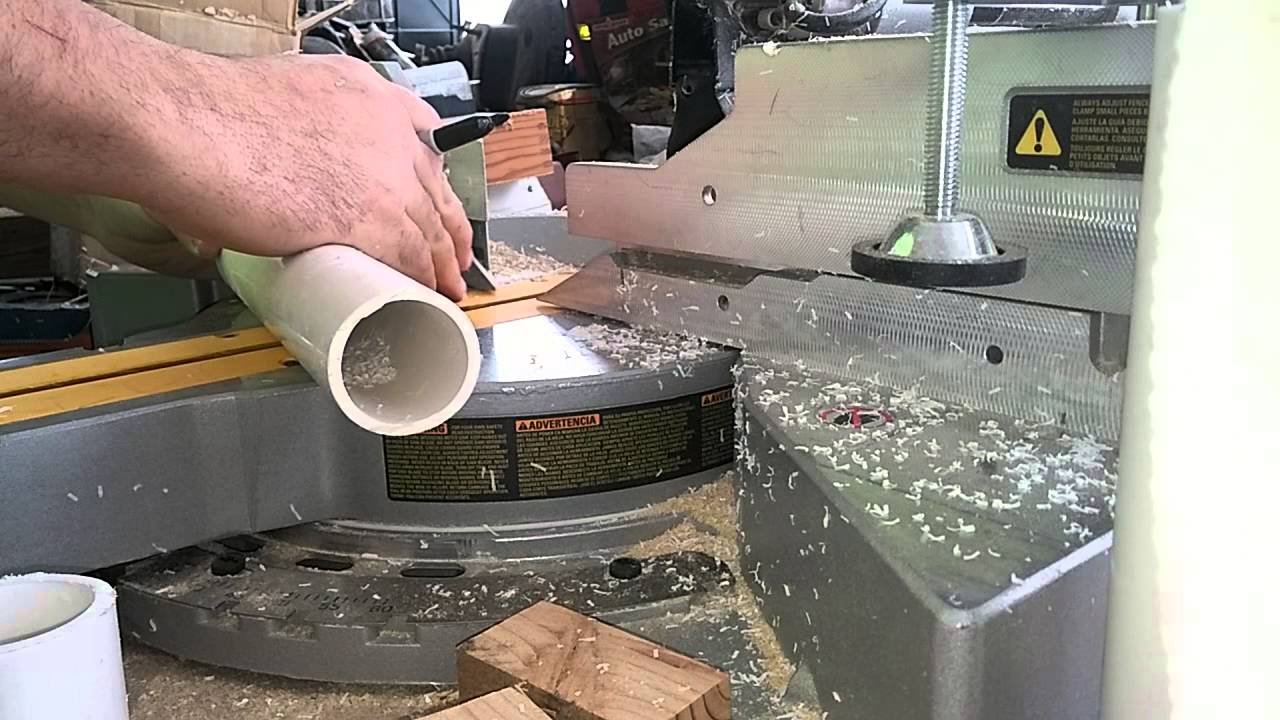
PVC pipe is round, so it can roll if you do not hold it properly. The main goal is a square, even cut so fittings seal well and slide on smoothly.
For pipe, focus on:
- Keeping the pipe from rolling
- Making the cut square
- Smoothing the inside and outside edge
PVC trim
PVC trim is flat and more visible, so appearance matters more. Clean corners and smooth edges are important because the cut will often be seen after installation.
For trim, focus on:
- Fine blades for smoother edges
- Careful angle settings
- Low chip-out on the face side
Here is one subtle point beginners often miss: trim needs a better finish than pipe, even if both are made of PVC. A pipe cut can sometimes be hidden inside a fitting. A trim cut usually cannot.
Helpful setup tips for a cleaner workshop result
A few simple habits can make your cuts safer and cleaner without buying new tools.
| Problem | Likely cause | Better approach |
|---|---|---|
| Rough edge | Coarse or dull blade | Use a sharp fine-tooth blade |
| Melting | Too much pressure or slow blade speed | Cut with steady, moderate feed |
| Pipe rolls during cut | Poor support | Hold securely or use a stop block |
| Chipped trim face | Blade too aggressive | Use a finish blade and support the back side |
| Poor fit in fittings | Burr left on the edge | Deburr before assembly |
Also, keep the saw area clean. Small plastic scraps can build up near the fence and affect later cuts. A quick brush-off between cuts is a simple habit that improves accuracy.
Should you use a special blade for PVC?
You do not always need a special PVC blade, but blade choice does matter. Many finish blades and crosscut blades work very well. The key is tooth count and sharpness.
If you cut PVC often, it may be worth using a blade dedicated to plastics or finish cuts. That helps keep your wood blade in better condition and gives more consistent results for plastic jobs.
For occasional projects, a clean, sharp general-purpose fine-tooth blade may be enough.
When not to cut PVC with a miter saw
Even though the answer to can you cut pvc with miter saw is yes, there are times when you should choose another method.
Avoid the miter saw if:
- The piece is too large to support safely
- The cut must happen in a tight space
- The PVC is already installed and cannot be removed easily
- You do not have a stable way to hold the piece
In these cases, a handsaw, PVC cutter, or oscillating tool may be more practical. The best tool is the one that gives you control without adding risk.
Credit: homedit.com
Final thoughts on cutting PVC the right way
A miter saw is one of the best tools for cutting PVC when the setup is right. It is fast, accurate, and easy to use for both pipe and trim. But the quality of the cut depends on a few simple things: the right blade, stable support, steady pressure, and good safety habits.
If you remember only one thing, remember this: do not force the cut. Let the blade stay sharp, keep the material secure, and finish the edge after cutting. Those small steps make a big difference in how the project turns out.
So yes, can you cut pvc with miter saw? Absolutely. When you use the saw carefully, it can give you clean results and save a lot of time on your next project.
FAQs
Can you cut PVC with a miter saw without melting it?
Yes, you can. Use a sharp fine-tooth blade, keep the feed speed steady, and do not push too hard. Slow, controlled cutting helps reduce heat and melting.
What kind of blade is best for cutting PVC on a miter saw?
A fine-tooth blade is usually best. Many finish or crosscut blades work well because they make smoother cuts and reduce chipping.
Do you need to clamp PVC before cutting it?
Clamping is not always required, but it is very helpful. PVC can move or roll, especially pipe. If the piece is small or unstable, clamping makes the cut safer and more accurate.
Can a miter saw cut PVC pipe and PVC trim boards?
Yes. A miter saw works well for both. Pipe needs good support so it does not roll, while trim boards need a clean blade and careful angle settings for a neat finish.
Should you deburr PVC after cutting?
Yes, especially for pipe. Removing burrs helps fittings slide on properly and gives the cut edge a cleaner finish. A quick pass with a knife or deburring tool is usually enough.
