
If you have ever tried to choose between two finish nailers that look almost the same, you are not alone. Many woodworkers, trim installers, and DIY users reach the same point: one model has a straight magazine, the other has an angled one, and both seem useful. That is where the real question starts.
The choice matters more than many people think. The wrong tool can make a simple trim job harder, slower, and even more frustrating. The right one can save time, fit into tight corners, and leave cleaner results with less effort.
This guide explains angled vs straight finish nailers in simple terms. You will learn how they differ, where each one works best, what to look for before buying, and which mistakes people often make when choosing between them.
What a finish nailer actually does
A finish nailer drives medium-sized nails into wood. It is often used for trim, baseboards, crown molding, door casings, window frames, and light furniture work. Compared with a brad nailer, it uses stronger nails and gives a firmer hold.
Finish nailers are popular because they make woodwork faster and cleaner. Instead of hammer marks and split trim, you get small nail holes that are easy to fill. They are also easier to control than a framing nailer, so they work well for visible interior projects.
The big difference in this article is not the power. It is the shape of the magazine, which changes how the tool fits, reaches, and feels in use.
The main difference between angled and straight finish nailers
The core difference is simple:
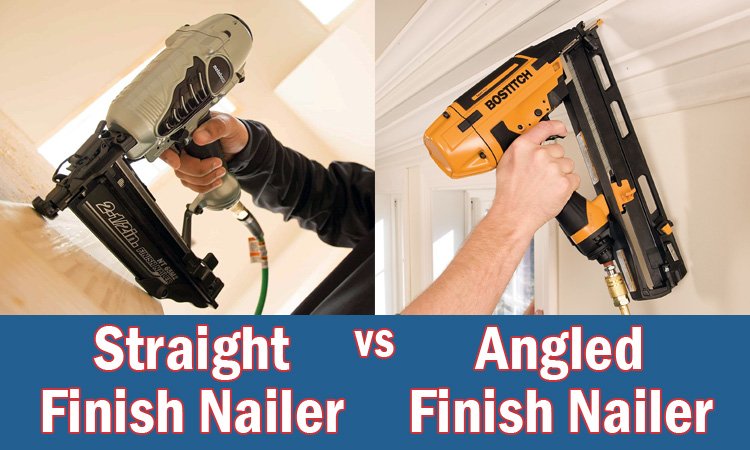
- Straight finish nailers have a magazine that runs in a straight line, usually at 90 degrees to the tool body.
- Angled finish nailers have a magazine set at an angle, often around 15 degrees, which changes how the nose reaches tight spaces.
That one design change affects more than storage or looks. It changes where the nailer can fit, how easy it is to aim, and what type of nails it uses. It can also change the balance of the tool in your hand.
Most users notice the difference first when working in corners or near walls. A straight finish nailer can feel bulky in tight spots. An angled model often slips into those places more easily.
How the magazine shape affects use
A straight magazine keeps the nail strip aligned in a simple, direct path. This is common in budget-friendly models and many general-purpose tools. Because the magazine is straight, the tool often feels familiar and easy to understand.
An angled magazine tilts the nail strip away from the tool body. That makes the nose slimmer in some places and helps the gun reach inside narrow trim gaps, cabinet corners, and other cramped areas. This is one of the biggest reasons professionals often choose angled models.
What nails each type uses
Angled finish nailers usually use nails that are joined in a strip with a slant. Straight finish nailers use nails in a straight strip. This matters because the nail type must match the tool exactly.
That is one of the hidden costs buyers miss. You cannot always swap nails between the two. If your local store stocks one style more than the other, that can affect long-term convenience and price.
Quick comparison of the two types
The table below gives a clear side-by-side view of the most important differences.
| Feature | Angled Finish Nailer | Straight Finish Nailer |
|---|---|---|
| Magazine shape | Angled, usually about 15 degrees | Straight, in line with the tool body |
| Best for tight spaces | Excellent | Limited |
| Tool size in corners | More compact at the nose | Bulkier |
| Nail type | Angled collated nails | Straight collated nails |
| Typical use | Trim, crown molding, cabinetry, cabinets | Baseboards, general trim, simple interior work |
| Cost | Often slightly higher | Often lower |
| Ease of finding nails | Good, but can vary by location | Usually easy for common jobs |
Why angled finish nailers are popular with professionals
Many pros prefer angled models because they solve real job-site problems. When you are installing trim all day, speed and access matter. A nailer that can fit where your hand cannot is a real advantage.
Credit: garagetooled.com
Better access in corners
This is the biggest reason. Angled finish nailers can get into inside corners more easily. That helps when you are nailing crown molding, door casings, cabinet trim, or decorative molding where the tool needs to stay clear of walls or nearby surfaces.
One detail beginners often miss: a few degrees of angle can make a big difference in clearance. It is not just about reaching a corner. It is also about keeping the tool body in a comfortable position while the nose stays where the nail needs to go.
Cleaner work on complex trim
When trim has layers, small returns, or tight joints, an angled nailer often makes the work feel less forced. You can keep the tool flatter against the workpiece and still place the nail where you want it.
More flexible on finish carpentry jobs
If you do mixed work, an angled finish nailer is often the more versatile choice. It handles many trim situations without making you stop and rethink tool position every few minutes.
Where angled models shine most
- Crown molding
- Door and window casing
- Cabinet face frames
- Inside corners
- Detailed trim around built-ins
Why straight finish nailers still make sense
Straight finish nailers are not old-fashioned or weak. They are still useful, especially if your work is simple and your access is open. For many homeowners, that is enough.
Lower cost is a real advantage
In many cases, straight models cost less. That can matter if you only need a finish nailer for occasional weekend projects. If you are installing baseboards in one room or fixing a few trim pieces, a lower-cost tool may be the smart move.
Simple, easy to understand
A straight finish nailer often feels straightforward. It is less likely to confuse beginners who want a tool that does one job well without extra planning. For people who are new to pneumatic or battery nailers, that simplicity can be valuable.
Good for open, easy-access work
If the area is open and you do not need to reach around corners, the straight model can perform just fine. For long runs of baseboard or simple trim installation in clear spaces, it can be a practical and affordable choice.
Best uses for angled finish nailers
If your work includes detailed trim or tight spaces, an angled finish nailer usually gives better results. It is not only about pro-level jobs. Many homeowners also benefit from the extra reach.
1. Crown molding
Crown molding is one of the best examples. The shape of the molding and the way it sits near the ceiling often leave very little room for a bulky tool. An angled nailer helps you place nails without fighting the space.
2. Cabinet and built-in projects
Cabinet trim, face frames, toe kicks, and built-in shelving often create awkward angles. An angled nailer makes these jobs much easier, especially when the tool has to fit inside a confined opening.
3. Tight inside corners
This is where many straight tools struggle. If the trim meets in a tight corner, the angled magazine can keep the nailer body out of the way while the nose stays aligned.
4. Repeated professional trim work
If you install trim often, the time saved by better access adds up. Even small gains matter when the same movement is repeated hundreds of times during a project.
Best uses for straight finish nailers
Straight finish nailers are best when the job is simple and space is open. They can still deliver a neat finish and solid hold if you are using them in the right setting.
1. Baseboards in open rooms
When walls are clear and corners are easy to reach, a straight finish nailer can do the job well. Baseboards usually do not demand the same tricky access as crown molding or cabinet work.
2. Basic interior trim
If you are adding simple window trim or door casing in an open area, straight models are often enough. They are also a decent choice for people who only plan a few trim projects each year.
3. Budget-conscious buyers
Not every project needs the more flexible option. If price matters more than maximum access, a straight finish nailer can give you the performance you need without paying for features you may never use.
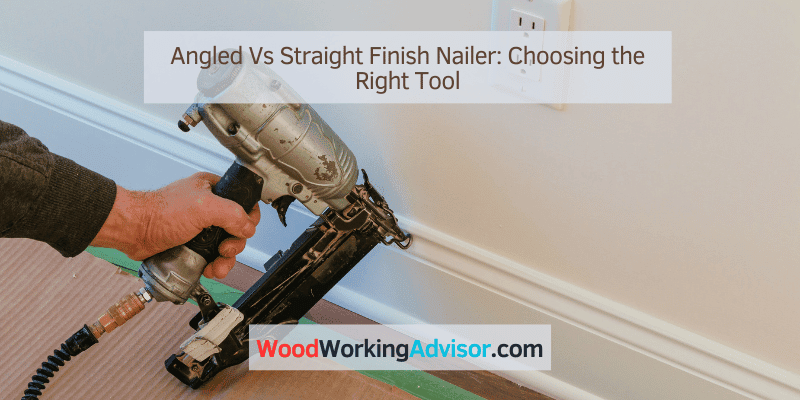
Pros and cons of angled finish nailers
Credit: woodworkingadvisor.com
Pros
- Better access in tight spaces
- Great for crown molding and detailed trim
- More flexible for professional finish work
- Often easier to work with around corners
Cons
- Usually costs more
- Uses angled nails, which may be less common in some stores
- Can feel slightly more specialized for beginners
Pros and cons of straight finish nailers
Pros
- Often less expensive
- Simple layout and easy to use
- Good for open, basic trim jobs
- Can be a practical starter tool
Cons
- Harder to use in tight corners
- Less flexible for complex trim work
- Not ideal for many professional finish applications
What most buyers forget before choosing
Many people compare only the angle and the price. That is not enough. A finish nailer should also match your project type, your access needs, and the nails you can buy easily.
1. Nail availability matters more than you think
If you run out of nails in the middle of a job, you want replacements that are easy to find. Before buying, check which nail strips are common in your area and online stores you already use.
2. The right tool depends on the trim style
Simple modern trim is different from detailed decorative molding. If your home has lots of crown, corner joints, or custom woodwork, an angled finish nailer is usually the safer pick.
3. Comfort is not just about weight
A tool may look light on paper, but balance matters too. A straight nailer can sometimes feel longer or more awkward in tight areas. An angled one may feel more natural if you work near walls or ceilings.
4. Think about future projects, not only the current one
This is a smart buying habit. If you only need one simple job done, a straight model may be enough. But if you think you will later install crown molding, cabinets, or more detailed trim, the angled version may save you from buying twice.
Common mistakes people make when comparing the two
Choosing between angled vs straight finish nailers gets easier when you know the usual mistakes.
- Choosing by price alone. The cheapest tool is not always the best value if it cannot reach the places you need.
- Ignoring nail compatibility. The gun and nail strip must match. This sounds basic, but many first-time buyers miss it.
- Buying for one project only. A tool should fit the next few jobs too, not just the one on your mind today.
- Overestimating how often “open space” really happens. Even simple trim jobs often include corners, returns, and awkward edges.
- Not checking local nail supply. A great tool becomes annoying if the right nails are hard to find.
Which one should you choose?
If you want the short answer, here it is:
Choose an angled finish nailer if you do detailed trim work, crown molding, cabinetry, or jobs with tight corners. It gives you more reach and more flexibility.
Choose a straight finish nailer if you want a lower-cost, easy-to-use tool for basic trim and open-area work. It is a solid choice for simpler home projects.
A good rule is this: if you are not sure, think about your hardest trim job, not your easiest one. The hard job is usually what reveals the better tool.
A simple decision guide
- If you work in tight spaces often, go angled.
- If you only do simple trim now and then, go straight.
- If you want one finish nailer for many types of trim, angled is usually the safer bet.
- If budget is the top concern, straight is often the more affordable path.
Safety and setup tips that improve results
No matter which type you choose, good setup matters. A finish nailer works best when the depth is adjusted properly and the tool is held firmly against the wood. A weak setup can leave nails proud, sink them too deep, or damage trim edges.
Credit: woodworkingadvisor.com
Use the right air pressure or battery setting
If you use a pneumatic model, follow the tool’s pressure range and test on scrap wood first. If you use a cordless model, check the drive depth setting before starting the real project.
Test on scrap before the finished piece
This saves time and material. A quick test helps you see whether the nail is too shallow, too deep, or hitting in the wrong place.
For safety details and nailer use basics, the OSHA website is a reliable authority.
Hold the tool flat and steady
Many missed shots happen because the nose was not flat on the wood. Even a small gap can cause poor nail placement or a bounce that marks the surface.
Final thoughts on angled vs straight finish nailers
The debate between angled and straight finish nailers is not about which one is “best” for everyone. It is about which one fits your work style, your project type, and your space. That is why the choice matters.
If your projects involve detailed trim, crown molding, or tight corners, the angled model will usually feel more capable and less frustrating. If your work is simple, open, and budget-focused, the straight model can still be a smart and effective tool.
When you understand the real differences, the decision becomes much easier. You stop buying based on guesswork and start buying based on how you actually work.
FAQs
1. Is an angled finish nailer better than a straight finish nailer?
Not always. An angled finish nailer is better for tight spaces and detailed trim work, but a straight finish nailer can be a better value for simple, open-area projects.
2. Can I use angled nails in a straight finish nailer?
No. The nail strip must match the tool design. Angled and straight finish nailers use different collations, so they are not usually interchangeable.
3. Which finish nailer is better for crown molding?
An angled finish nailer is usually the better choice for crown molding because it reaches corners and awkward spaces more easily.
4. Are straight finish nailers good for beginners?
Yes. Straight finish nailers can be a simple and affordable option for beginners who plan to do basic trim or baseboard work.
5. Why do professionals often prefer angled finish nailers?
Professionals often choose angled finish nailers because they save time in tight spaces, work better on complex trim, and handle a wider range of finish carpentry tasks.
