
If a battery stops working, many people replace it right away. That can be a mistake. In many cases, the battery still has some life left, or the real problem is poor contact, corrosion, or a charging issue. The fastest way to know what is happening is to test it with a multimeter.
Learning how to test a battery with a multimeter gives you a simple skill that saves time, money, and guesswork. You can check small household batteries, car batteries, rechargeable packs, and more. The process is not hard, but the details matter. A battery can show a normal voltage and still fail under real use, so you need to read the numbers correctly.
In this guide, you will learn the exact steps, the right multimeter settings, and the mistakes that lead to wrong results. You will also see how to judge whether a battery is truly good, weak, or dead.
If you are working on a vehicle or electrical system, you can also test a car battery with a multimeter or check ground with a multimeter to narrow down the real fault.
What a multimeter actually tells you
A multimeter measures voltage, and sometimes current and resistance. For battery testing, voltage is the most useful setting. It tells you how much electrical pressure the battery can provide at rest. That number gives a strong clue about battery health.
But here is something many beginners miss: open-circuit voltage is not the same as real performance. A battery can show a decent voltage with no load and still fail when you put it into a device. That is why you should think of a multimeter reading as a first test, not always the final answer.
For most simple checks, you only need DC voltage mode. The exact setting depends on the battery type and the expected voltage. If your multimeter has auto-ranging, it will choose the range for you. If it is manual-ranging, choose a range just above the battery’s rated voltage.
Why voltage matters
Voltage is the easiest way to see if a battery is near full, partly used, or deeply discharged. For example, a fresh 1.5V alkaline battery usually reads a little above 1.5V when unused. A nearly empty one will read much lower. For a 12V car battery, the numbers are different, but the same idea applies.
Still, voltage alone does not tell the whole story. Internal wear, age, and temperature can all affect how a battery behaves. That is why you should also look at the battery type, its age, and what the device is doing.
If you are working on a vehicle or electrical system, you can also test a car battery with a multimeter or check ground with a multimeter to narrow down the real fault.
What you need before you begin
You do not need special tools. A basic digital multimeter is enough for most battery tests. Analog meters can work too, but digital meters are easier to read and more accurate for beginners.
- Digital multimeter
- Battery to test
- Clean cloth or paper towel for wiping dirty terminals
- Gloves if you are testing a car battery or a large battery pack
- Safety glasses for larger batteries
If you want a general safety reference for battery handling, the OSHA website is a reliable place to start. It covers workplace safety practices that also apply to battery testing in more serious setups.
Before testing, inspect the battery. If you see swelling, leakage, heavy corrosion, or damage, stop and handle it carefully. A damaged battery may be unsafe even if the voltage looks normal.
If you are working on a vehicle or electrical system, you can also test a car battery with a multimeter or check ground with a multimeter to narrow down the real fault.
How to test a battery with a multimeter step by step
The process is simple. The key is to use the right setting and read the display correctly. Follow these steps closely.
1. Turn the multimeter on and select DC voltage
Find the voltage symbol on your meter. It usually looks like V with a straight line and dashed line, or it may say DCV. Do not use AC voltage mode, because batteries produce direct current, not alternating current.
If your meter is manual-ranging, choose a range higher than the battery voltage. For a 1.5V battery, choose 2V or 20V if 2V is not available. For a 9V battery, choose 20V. For a 12V battery, choose 20V or higher.
2. Insert the probes correctly
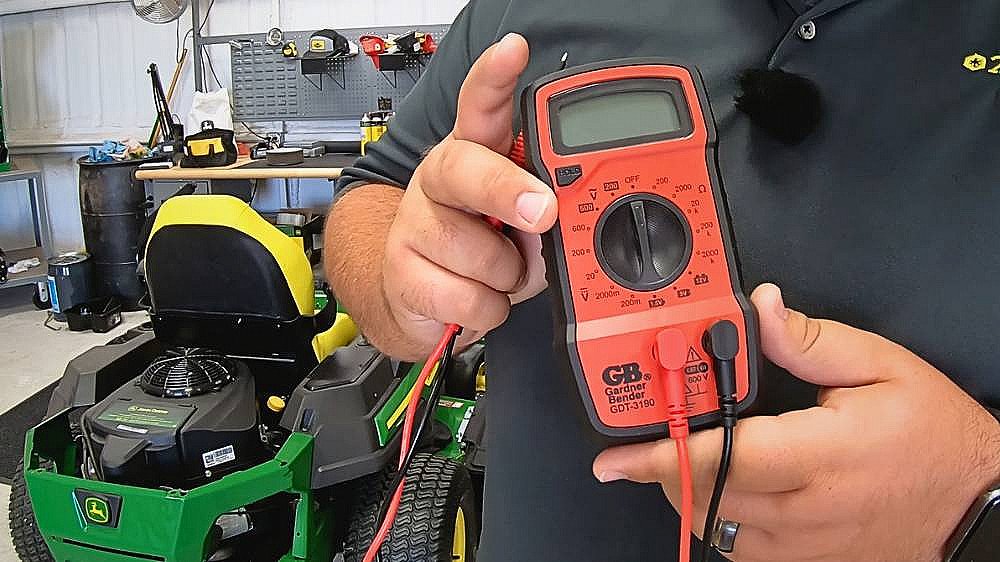
Place the black probe into the COM port. Place the red probe into the port marked for voltage, usually V or VΩ. This is a small step, but it matters. If the probes are in the wrong ports, your reading may be wrong or the meter may not work as expected.
3. Touch the probes to the battery terminals
Touch the red probe to the positive terminal and the black probe to the negative terminal. The positive side is often marked with a plus sign. On many batteries, the positive end is also the raised side.
Hold the probes steady. Do not let them slip and touch each other. For small batteries, a stable hand is enough. For larger batteries, clip leads can make the process easier.
4. Read the voltage on the display
Look at the number on the screen. If the meter shows a minus sign, the probes are reversed. That does not usually harm the meter. It only means the red and black probes are swapped. You can switch them to get a positive reading.
Write the number down if you want to compare several batteries. This is useful when testing a pack of batteries from the same device.
5. Compare the result with the battery type
Do not judge the battery by the number alone. Compare it with the expected voltage for that battery type. A 1.5V battery, a 9V battery, and a car battery all have different healthy ranges.
| Battery type | Typical full/resting voltage | Weak or low range |
|---|---|---|
| AA or AAA alkaline | About 1.5V to 1.65V | Below about 1.2V |
| 9V alkaline | About 9.4V to 9.6V | Below about 8.2V |
| Lead-acid car battery | About 12.6V to 12.8V | Below about 12.4V |
| Lithium-ion cell | About 3.6V to 4.2V | Below about 3.3V |
These numbers are practical guides, not absolute laws. Some batteries may show slightly different values depending on brand, age, and temperature.
If you are working on a vehicle or electrical system, you can also test a car battery with a multimeter or check ground with a multimeter to narrow down the real fault.
How to test common battery types the right way
Different batteries behave differently. A good reading on one type may mean something completely different on another. That is why the battery type matters as much as the voltage number.
Credit: autozone.com
AA, AAA, C, and D batteries
These are usually alkaline batteries in home devices like remotes, toys, and flashlights. Set the meter to DC voltage, then touch the probes to each end. A fresh battery often reads a bit above its labeled voltage. If the reading falls much below 1.2V for a 1.5V battery, it is usually weak.
Non-obvious insight: A battery can still power a very low-drain device even when it is too weak for a flashlight. So if a remote control stops working, test the battery in the meter instead of assuming the battery is completely dead.
9V batteries
These batteries are common in smoke alarms, audio gear, and meters. Because they have a higher voltage, they are easy to test. A healthy 9V alkaline battery should usually read above 9.4V when unloaded. If it is near 8V or lower, it is often near the end of useful life.
Non-obvious insight: Some 9V batteries show decent voltage but fail fast because they have very little usable capacity left. If the battery is for a safety device like a smoke alarm, replace it early instead of waiting for a total failure.
Car batteries
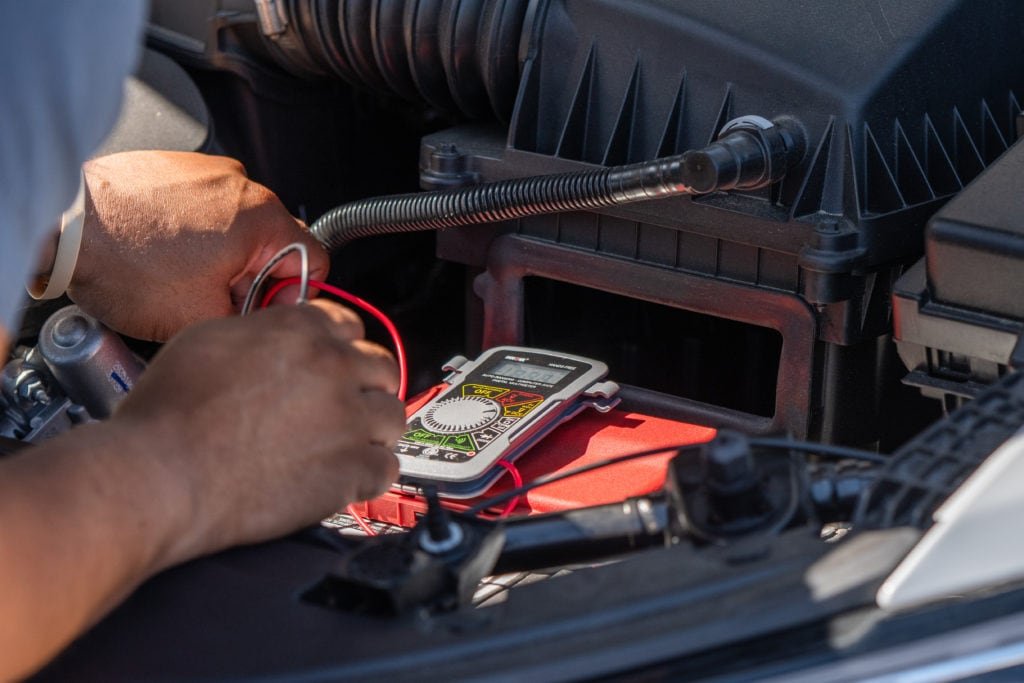
Car batteries need a little more care. Test them when the engine is off and the car has been sitting for a while. A fully charged 12V lead-acid battery usually reads around 12.6V to 12.8V. If it is around 12.4V, it is only partly charged. If it is below 12.0V, it is seriously discharged.
For car batteries, a resting voltage test is only part of the story. A battery may still look okay at rest but fail during starting. In that case, you may need a load test or a professional test.
Rechargeable lithium-ion batteries
Lithium-ion cells are common in phones, tools, cameras, and power banks. A single cell usually has a nominal voltage of about 3.6V or 3.7V, and a full charge is often around 4.2V. If a cell is below about 3.3V, it may be deeply discharged.
Be careful with damaged lithium batteries. If they are swollen, hot, leaking, or smell unusual, do not test them casually. Safety matters more than the reading.
If you are working on a vehicle or electrical system, you can also test a car battery with a multimeter or check ground with a multimeter to narrow down the real fault.
How to judge whether the battery is good, weak, or dead
A multimeter result becomes useful when you know how to read it. The same battery can fall into different categories depending on type and use.
Good battery
A good battery should be close to its expected resting voltage. For example, a fresh AA battery should be above 1.5V, and a healthy car battery should usually be above 12.6V when rested.
Weak battery
A weak battery may still work in light-duty devices, but it is nearing the end. It may show enough voltage for simple electronics but fail under heavier demand. This is where many people get confused. They see a number that looks acceptable and think the battery must be fine. It may not be.
Dead battery
A dead battery shows very low voltage or no meaningful voltage. For many household cells, a reading far below the normal range means replacement is the best choice. For rechargeable batteries, repeated deep discharge can also damage the battery permanently.
If you are working on a vehicle or electrical system, you can also test a car battery with a multimeter or check ground with a multimeter to narrow down the real fault.
Why a battery can show voltage and still fail
This is one of the most important ideas in battery testing. A meter test with no load is only a snapshot. It does not show how the battery behaves when the device actually asks for power.
Here are the most common reasons:
- The battery has high internal resistance.
- The battery is old and has lost capacity.
- The battery has a poor connection in the device.
- The device itself is drawing more power than normal.
- The battery was tested after resting, but fails under load.
If you need a more complete answer, test the battery in the device or use a load tester. This is especially important for car batteries and rechargeable battery packs.
Credit: west-equip.com
If you are working on a vehicle or electrical system, you can also test a car battery with a multimeter or check ground with a multimeter to narrow down the real fault.
Common mistakes that lead to wrong readings
Many bad test results come from simple errors, not bad batteries. If your reading does not make sense, check these points first.
Using AC mode instead of DC mode
This is the easiest mistake to make. A battery is DC. If you use AC mode, the reading will be useless or unstable.
Touching the wrong terminals
If the red and black probes are reversed, the reading may show a minus sign. That is not dangerous, but it can confuse beginners.
Testing dirty or corroded terminals
Corrosion can block proper contact. Clean the terminals lightly before testing. A dirty battery may look weak when it is not.
Reading the battery right after heavy use
Some batteries recover slightly after being removed from a device. Others show a temporary voltage drop during use. Let the battery rest for a few minutes if you want a cleaner resting voltage reading.
Assuming one voltage number tells the whole story
This is a major beginner mistake. Voltage is useful, but it does not show full capacity. A battery can pass a voltage test and still be too weak for real work.
If you are working on a vehicle or electrical system, you can also test a car battery with a multimeter or check ground with a multimeter to narrow down the real fault.
How to test batteries in a pack
If a device uses several batteries together, test each one separately. Do not just test the whole pack and stop there. One weak battery can bring down the whole set.
For example, if a flashlight uses four AA batteries, one weak cell can make the light dim or unstable. Mix of new and old batteries is another common problem. Batteries in the same device should usually be the same type, same brand, and similar age.
Here is a good habit: test every battery in the set and group them by voltage. If one is much lower than the others, replace the whole set or at least remove the weak one.
If you are working on a vehicle or electrical system, you can also test a car battery with a multimeter or check ground with a multimeter to narrow down the real fault.
How to test batteries safely
Battery testing is usually safe, but caution is still important. Small batteries are low risk, yet larger batteries can give off heat, sparks, or harmful leaks if handled badly.
- Do not short the terminals with the probes.
- Do not test damaged or swollen batteries without care.
- Keep metal tools away from exposed battery terminals.
- For car batteries, avoid loose jewelry and be careful around the terminals.
- Test in a dry area, away from water.
If a battery becomes hot during testing, stop and check it. Heat is a warning sign that something may be wrong.
If you are working on a vehicle or electrical system, you can also test a car battery with a multimeter or check ground with a multimeter to narrow down the real fault.
When voltage testing is not enough
There are times when a multimeter check is only the first step. If the battery seems okay but the device still fails, you may need more testing.
Load testing
A load test checks how a battery behaves while power is being drawn. This is very helpful for car batteries and larger rechargeable batteries. A battery that looks fine at rest may collapse under load.
Device testing
Sometimes the battery is not the problem. A device may have bad contacts, a broken switch, or a short circuit. If possible, test a known good battery in the device before replacing more batteries.
Charging system testing
For rechargeable systems, the charger may be the real issue. A battery may appear weak because it was never charged correctly. In that case, testing only the battery can lead you in the wrong direction.
If you are working on a vehicle or electrical system, you can also test a car battery with a multimeter or check ground with a multimeter to narrow down the real fault.
Smart habits that help you get better results
Good battery testing is part skill and part habit. Once you learn the basics, these small practices make your results more reliable.
- Test batteries at room temperature when possible.
- Write down readings if you compare multiple batteries.
- Use the same multimeter for similar tests when you can.
- Replace batteries in sets if one unit is much weaker than the others.
- Do not trust a battery just because it is new from the package.
That last point surprises many people. New batteries can still sit in storage for a long time, and some lose charge before use. A quick multimeter test can save time before you put them in an important device.
If you are working on a vehicle or electrical system, you can also test a car battery with a multimeter or check ground with a multimeter to narrow down the real fault.
Simple example of the process
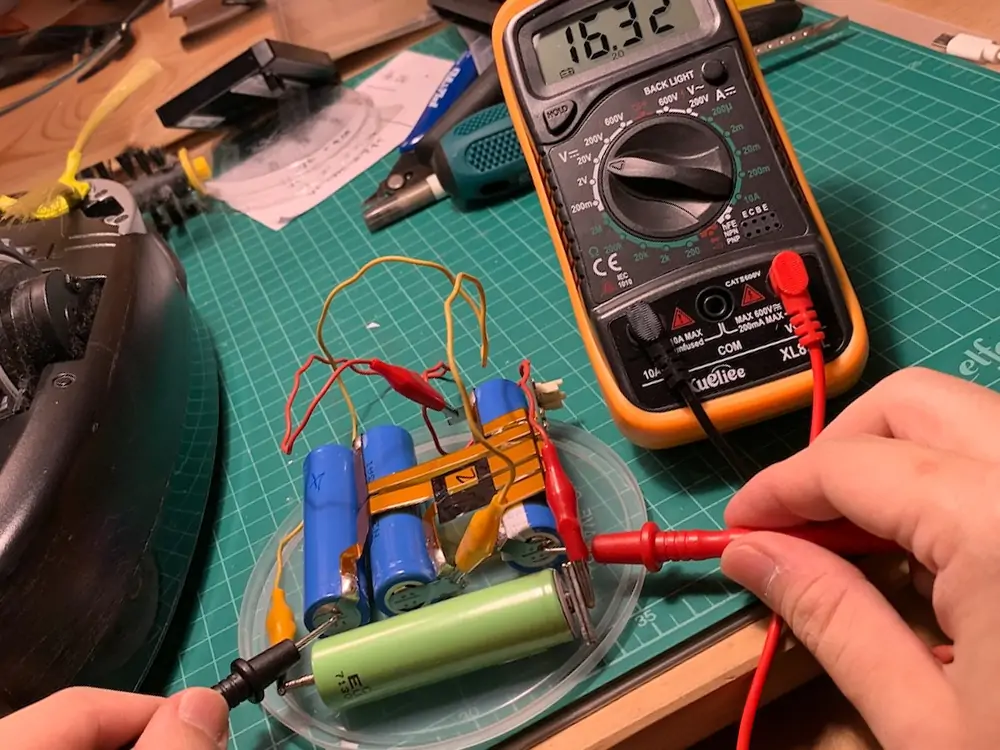
Suppose a flashlight stops working. You remove the AA battery and test it with your meter. The reading is 1.28V. That is not empty, but it is lower than a fresh battery and may be too weak for a brighter device. If the flashlight still does not work with a new battery, the problem may be the contacts or switch.
Now imagine a 12V car battery reads 12.1V after sitting overnight. That suggests a low charge. If the car also starts slowly, the battery may be worn or undercharged. If it reads 12.7V but still struggles to start the engine, a load test may reveal the real problem.
Credit: legendbatteries.com
If you are working on a vehicle or electrical system, you can also test a car battery with a multimeter or check ground with a multimeter to narrow down the real fault.
Final checks before you replace a battery
Before you throw a battery away, ask three questions:
- Is the battery type correct for the device?
- Is the voltage low for that battery type?
- Could the real problem be the device, contacts, or charger?
If the answer to the first two is yes, replacement is probably the right move. If not, test more carefully before spending money on new batteries.
Once you understand how to test a battery with a multimeter, you can solve many common power problems in minutes. It is a small skill, but it gives you a big advantage. You will waste less money, avoid guesswork, and make better decisions about when to keep a battery and when to replace it.
If you are working on a vehicle or electrical system, you can also test a car battery with a multimeter or check ground with a multimeter to narrow down the real fault.
Frequently Asked Questions
1. Can I test any battery with a multimeter?
Yes, you can test most common batteries with a multimeter as long as you use the correct DC voltage setting. This includes AA, AAA, 9V, car batteries, and many rechargeable cells. Very specialized battery packs may need extra care.
2. What should a new AA battery read on a multimeter?
A new AA alkaline battery often reads a little above 1.5V, sometimes around 1.55V to 1.65V. Exact numbers vary by brand and storage time. If it is much lower than 1.2V, it is likely weak.
3. Why does my battery show voltage but the device still does not work?
This often happens when the battery has enough resting voltage but cannot deliver power under load. Dirty terminals, bad contacts, or a faulty device can also cause the same problem. Voltage alone does not always prove full battery health.
4. Is it safe to test a car battery with a multimeter?
Yes, it is generally safe if you are careful. Use the correct DC voltage range, avoid shorting the terminals, and keep metal objects away from the battery posts. If the battery is swollen, leaking, or hot, stop and handle it with caution.
5. Do I need a special multimeter to test batteries?
No, a basic digital multimeter is enough for most battery tests. Auto-ranging models are easier for beginners, but manual-ranging meters also work well once you know how to choose the correct setting.
